
Beyond Thing 1 and Thing 2: Cryptoassets and the New Property Landscape
For almost 140 years, bright-eyed law students have been taught that the world of personal property contains only two species of thing: those which can be physically held, and those which can be enforced. Cryptoassets forced the issue.
“Then out of the box came Thing Two and Thing One!”
– The Cat in the Hat, Dr Seuss
‘A thing (including a thing that is digital or electronic in nature) is not prevented from being the object of personal property rights merely because it is neither— a) a thing in possession, nor b) a thing in action.’
– Property (Digital Assets etc) Act 2025 (Royal Assent 2 December 2025)
For almost 140 years, bright-eyed law students have been taught that the world of personal property contains only two species of thing: those which can be physically held, and those which can be enforced. In old common law language, those are choses in possession and choses in action. The usual starting point is Fry LJ’s famous statement in Colonial Bank v Whinney that all personal things are either in possession or in action, and that the law knows no tertium quid between the two. It was a neat formulation, and for a very long time it more or less did the job.
There had, of course, been the odd tremor in that apparent certainty. Milk quotas, export quotas, carbon allowances and the like had already shown that the law was capable of recognising valuable intangible rights which did not sit especially comfortably within the old two-box scheme. The Law Commission itself points to those examples as part of the reason why it would be wrong to pretend the common law had always been operating with total conceptual tidiness. Still, the orthodoxy remained remarkably resilient. If an asset did not fit the categories, the instinct was usually to blame the asset rather than question the categories.
It was really cryptoassets that forced the issue. They were the awkward guest at the property party: plainly valuable, plainly capable of being controlled, transferred and fought over, but stubbornly resistant to classification as either a thing in possession or a thing in action. Their intangible nature means they cannot be possessed in the ordinary sense. But nor, in many cases, do they consist of a right enforceable against an identifiable obligor. Bitcoin is not a watch, but neither is it a debt. That was the problem. Cryptoassets were not misbehaving; they were exposing the limits of a Victorian taxonomy.
That difficulty was squarely confronted in AA v Persons Unknown. Bryan J recognised the problem in terms that have since become familiar: cryptoassets were neither choses in possession nor choses in action, but that did not mean they could not be property. Adopting the reasoning of the UK Jurisdiction Taskforce, he treated it as fallacious to assume that English law recognises no form of property beyond those two traditional categories and held that cryptoassets were capable of being the subject of a proprietary injunction. From there the common law did what, at its best, it tends to do: it adapted. Since AA, the courts have continued to treat digital assets as capable of attracting personal property rights, even while working out the detail case by case.
That brings us to the Property (Digital Assets etc) Act 2025, one of the shortest Acts on the books, as Sir Geoffrey Vos has observed. Its effect is simple but important: a thing is not prevented from being the object of personal property rights merely because it is neither a thing in possession nor a thing in action. That does not mean Parliament has declared every digital novelty to be property. Quite the reverse. The brilliance of the Act lies in its restraint. It removes the old conceptual roadblock without attempting an exhaustive statutory definition of every crypto-token, NFT or future digital contraption dreamt up by people with too much time and a white paper.
That was also the Law Commission’s view. Whether a particular thing should fall within a third category of property rights is, it said, ‘a complex and dynamic question, which is ill-suited to static definition in statute’. Better to let the courts continue to identify the thing in question, decide whether it is capable of attracting property rights, and develop the law incrementally.
In the same spirit, the Law Commission preferred the language of control over any attempt to force digital assets into the older language of possession. That seems to me plainly right. Anyone who has had to deal with wallets, seed phrases, exchanges, or the sudden appearance of a spouse who becomes a blockchain evangelist halfway through Form E will know that ‘control’ is the concept that actually matters to the parties.
For financial remedy practitioners, the Act does not solve the usual headaches: disclosure, tracing, valuation, liquidity, volatility, or indeed add-backs for wanton expenditure on memecoins. But it does matter. It puts beyond doubt that the old club of Thing 1 and Thing 2 is no longer exclusive. And that is useful. It means we can spend a little less time worrying whether the asset exists in law at all, and a little more time arguing about what it is worth and who should get it which is, after all, more our line of work.
Related
Culligan v Culligan [2025] EWFC 1

Cryptoasset Fraud and Recovery - Disclosure and Constructive Trusteeship Through Knowledge / Assistance: The (Financial) Empire Strikes Back

Cryptocurrency and the Family Courts – Some International Experiences


Related
Culligan v Culligan [2025] EWFC 1
Cryptoasset Fraud and Recovery - Disclosure and Constructive Trusteeship Through Knowledge / Assistance: The (Financial) Empire Strikes Back
Cryptocurrency and the Family Courts – Some International Experiences
Latest

Beyond Thing 1 and Thing 2: Cryptoassets and the New Property Landscape
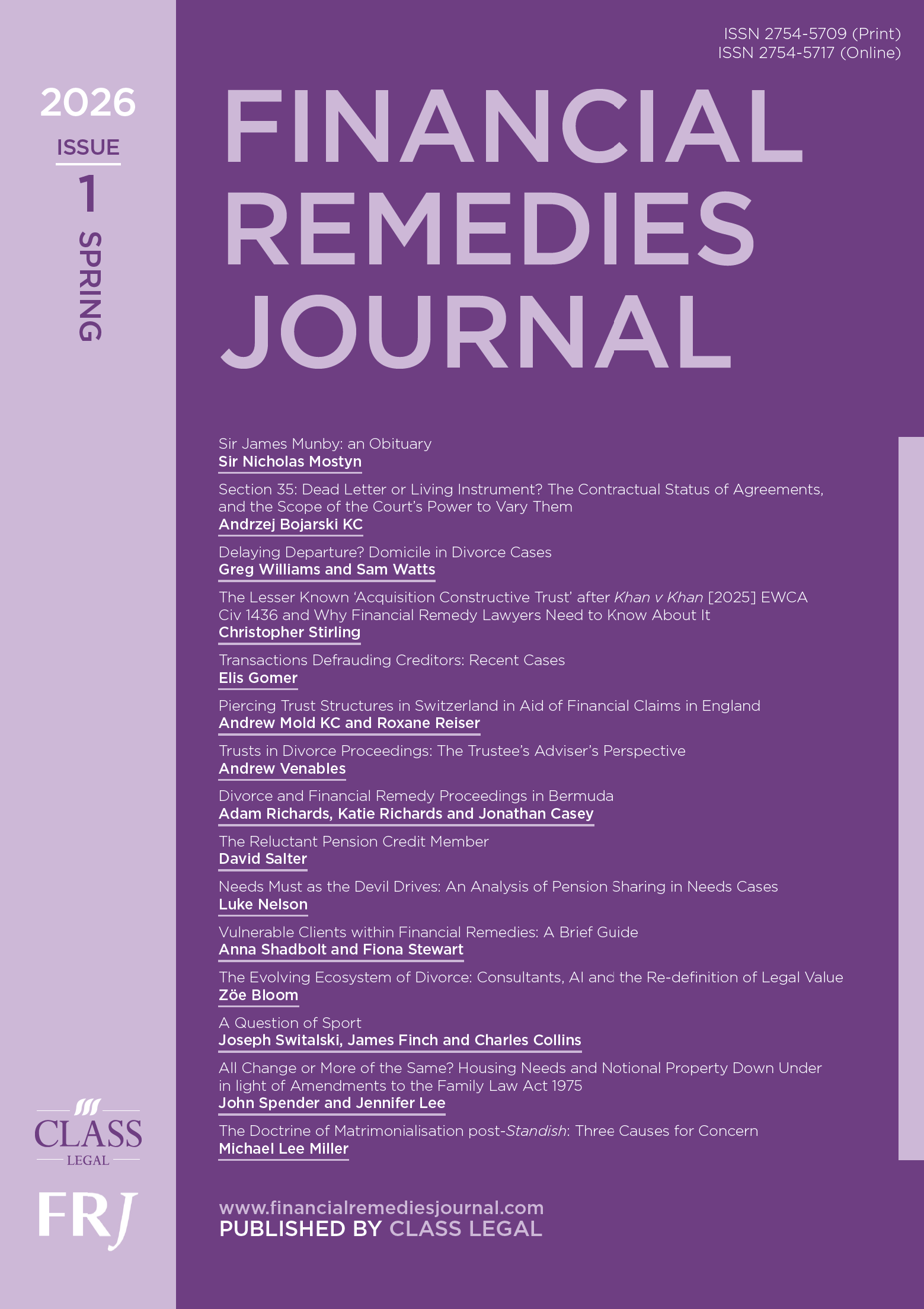
Now out: Financial Remedies Journal 2026 Issue 1 (Spring 2026)