
Divorce and Financial Remedy Proceedings in Bermuda
[2026] 1 FRJ 35. Bermuda has a large expatriate community, with many guest workers on time-limited contracts, so family disputes often involve difficult jurisdictional questions, including the appropriate forum for divorce and a high number of applications for permission to remove children.
Despite its small size, Bermuda punches well above its weight legally
Boasting pink-sand beaches, turquoise waters and abundant sunshine, Bermuda consists of approximately 180 islands located in the North Atlantic Ocean. Small in stature, measuring just 21 square miles and being home to only 60,000 people, Bermuda blends British heritage with island soul.
The warmer climes and relaxed pace should not, however, be misconstrued; Bermuda packs a punch as a significant global hub for insurance and reinsurance and is a major centre for investments and offshore trusts.
Indeed, Bermuda is a high-wealth, high-cost jurisdiction. In 2023, the island’s capital, Hamilton, topped a poll of the world’s most expensive cities, with a cost-of-living index of 142.1, meaning it was 42.1% more expensive than New York. In 2024, its GDP per capita was $138,935.
Bermuda has a highly sophisticated and well-established legal system which supports and encourages international business. As a British Overseas Territory, Bermuda is a common law jurisdiction which is historically rooted in the law of England and Wales. Privy Council decisions are binding with English authorities being highly persuasive. Complex commercial litigation is commonplace.
These factors mean that, as family attorneys practicing in Bermuda, we commonly represent parties with considerable incomes (often incorporating complex bonus payments, share options and long-term incentive structures). Unsurprisingly, sizeable incomes are coupled with sizeable wealth, with cases involving assets in the multiple millions being the norm rather than the exception.
Generational wealth is also extremely common. Complex corporate vehicles and, in particular, trust structures, are readily utilised to protect assets and provide for dynastic support. A significant knowledge of the law on trusts and their application in Bermuda is required on a daily basis (see below).
The presence of international business coupled with a small local population means Bermuda has a large expatriate community, with numerous guest workers on time-limited contracts producing a transient population. Family disputes therefore often involve difficult and intriguing jurisdictional questions including the appropriate forum for divorce and a high number of applications for permission to remove children from the jurisdiction to return to one parent’s country of origin.
The quality of family law work in Bermuda is therefore complex, always interesting and hugely fulfilling.
The general approach to financial claims
As a general statement, litigation is quite common and family law cases in Bermuda can often be lengthy, expensive and occasionally acrimonious.
The litigious approach is partly due to the money involved, but the situation is also, to a large extent, exacerbated by the legal framework in Bermuda.
Financial claims on divorce are determined having regard to the provisions of the Matrimonial Causes Act 1974 (the Bermuda MCA) which largely reflects the corresponding and original version of the Matrimonial Causes Act 1973 in England and Wales (the E&W MCA). The Bermuda MCA has not, however, been significantly updated save that ‘no fault’ divorce provisions were introduced in March 2023. This allowed parties seeking to divorce to proceed on the single ground that the marriage had broken down irretrievably, ending the previous requirements to cite fault or adultery. These amendments have thankfully reduced some of the early acrimony; however, greater reform is still required.
Given that the raft of amendments introduced in the English and Welsh legislation have generally not been replicated in Bermuda, there are some small yet significant differences in the legal landscape pertaining to financial claims post-divorce. In particular, the amendments introduced by the Matrimonial and Family Proceedings Act 1984 have not been implemented in Bermuda, save that the Matrimonial Causes Rules 2023, which now govern the procedure on divorce and ancillary claims in Bermuda, repealed the proviso (commonly referred to as the ‘tailpiece’) at the end of section 29(1) Bermuda MCA (section 25(2) E&W MCA). The tailpiece required the court so far as is possible to put parties back in the financial position they would have been but for the divorce. Bermuda courts had, with some difficulty, applied the provision generously until that amendment, and interpreted that section to mean the aim of the court was to achieve a fair outcome. That interpretation thereby broadly brought Bermuda in line with the overriding objective for determining financial claims in England and Wales.
Although the Bermuda courts seek to apply modern principles derived from UK precedent, those principles are based not only on socio-economic and policy considerations, but also on the specific wording of the statutory amendments, absent from our legislation. That distinction in Bermuda creates complex considerations as the courts try to apply modern considerations and guidance constrained by statutory limitations.
Differences in Bermuda family law
The following are the significant differences to contemplate when considering financial claims under Bermuda law compared to the position in England and Wales:
(1) One of the more complex issues concerns seeking to achieve finality on divorce. Although Bermuda courts recognise the desirability of achieving a clean break, the Bermuda MCA does not contain the so-called ‘statutory steer’ and the clean break principle enshrined in section 25A E&W MCA. Accordingly, there is no statutory requirement to consider whether it would be just and reasonable to end the financial obligations between spouses. As such, the court does not have power to dismiss a claim for periodical payments and finality can generally only be achieved by consent. Until quite recently, lifetime periodical payments orders were quite common. Although their existence is much less widespread now, such orders are not as rare as they are in England and Wales. The ability to achieve a clean break is further complicated by the high cost of living, meaning there are often insufficient assets to achieve final financial separation. A reasonable 3-bed family property in Bermuda will often cost in excess of a million dollars. Furthermore, there are restrictions for non-Bermudians on purchasing properties. These two factors mean that save for the wealthiest of Bermudians, housing needs are typically met by renting rather than purchasing. Given it is not unusual for rent of a 3-bed property to be upwards of $8,000 per month, ongoing financial support can be appropriate in certain cases.
(2) More problematic omissions from the Bermuda MCA include the inability of the court to order the sale of a property. This presents difficulties in cases with minimal assets or liquidity issues where the ability to buy out the other party is restricted. The courts have also held recently that this precludes the ability to order a Mesher-type arrangement as the court cannot order a deferred sale.
(3) Conduct, which was added as section 25(2)(g) E&W MCA in 1984, is not replicated in the Bermuda MCA. Conduct was previously referenced, albeit in a different context, in the ‘tailpiece’. However, following the repeal of that proviso in 2023, no provision was inserted in its place and, as such, consideration of ‘conduct’ is not a statutory requirement when considering financial claims in Bermuda. Given the limited examples of conduct impacting financial awards historically, this has not been a significant issue since the repeal. However, it will be interesting to see the approach adopted by the Bermuda courts going forward given the recent developments in the case law in relation to financially controlling and coercive behaviour.
(4) Bermuda does not have pension sharing or splitting provisions. Pensions can, however, be shared either by an offset of other assets (as most pensions in Bermuda save for government schemes are defined contribution plans) or a simple transfer of a specific portion of funds accumulated into the spouse’s pension fund.
(5) The level of wealth in Bermuda encourages urgent applications for interim maintenance where the monthly sums claimed can be very significant. Frequently, interim maintenance claims will include provision for legal fees payments. Bermuda does not have an equivalent section to s 22ZA E&W MCA but instead relies upon the common law guidance in Currey v Currey (No 2) [2006] EWCA Civ 1338. These hearings can often span several days of court time.
The Bermuda MCA is supported by the Matrimonial Causes Rules 2023. These rules amended the original 1974 rules in so far as was necessary to implement the ‘no fault’ divorce rules. The procedure in Bermuda remains otherwise largely unchanged from that prescribed in 1974 and is therefore very different to its English and Welsh counterpart. Financial claims are commenced by Notice with supporting affidavits. These are often lengthy and can include emotive rhetoric which is unlikely to impact the final decision. The absence of updated rules means Bermuda does not currently utilise a Form E, and there are no First Appointments or FDR hearings. There is no requirement to make open offers or to advise as to legal fees incurred at each stage of proceedings.
The modern provisions on costs are also absent from the Bermuda rules. Order 62/3(3) Rules of the Supreme Court 1985 (RSC) provides, as a general principle and starting-point, that where the court in the exercise of its discretion sees fit to make any order as to costs of any proceedings, that costs should follow the event unless it appears to the court that another order should be made, having regard to the circumstances of the case.
RSC Order 62/3(5), however, excludes proceedings under the Bermuda MCA from that general principle, i.e. costs do not follow the event. The courts in Bermuda have interpreted that section and consistently held in recent years that the starting point in family cases is no order as to costs.
Trusts in Bermuda
As an offshore jurisdiction, the concept of trusts is not only well recognised but a core component of Bermuda’s commercial appeal as an international financial centre. Bermuda trust law is based on English trust law and remains heavily influenced by English case law. However, the law has been enhanced in certain areas by local legislation. Significantly, like many offshore jurisdictions, Bermuda has enacted firewall legislation designed to ensure that any trust governed by Bermuda law will be insulated against rights and claims conferred by foreign law, including claims on divorce. These provisions have been strengthened significantly by the Trusts (Special Provisions) Amendment Act 2020 (TSPA). The most relevant provisions are as follows:
- section 9 provides that the Bermuda court shall have express jurisdiction to adjudicate claims concerning the validity, construction, effects or administration of a Bermuda trust where provided for in the trust instrument;
- section 10(3) excludes the application of foreign law to Bermuda trusts (subject to certain exceptions, for example, section 10 does not apply to foreign land); and
- section 11 which prevents the enforcement or recognition of any foreign judgment in conflict with the firewall provisions.
The legislation is significant in the context of matrimonial proceedings as it may preclude enforcement of any foreign orders which affect a Bermuda trust whether directly or indirectly. It should be noted that the TSPA defines a Bermuda trust broadly as a trust with a ‘Bermuda connection’ and does not require either the settlor or trustees to be resident in Bermuda. The legislation therefore confers jurisdiction to make orders with extraterritorial effect, although the enforcement of such orders would be determined in accordance with relevant foreign laws.
General approach to trusts on divorce
Bermuda’s matrimonial law similarly derives from English law and the primary legislation (the Bermuda MCA) mirrors the E&W MCA. Although later amendments to the English legislation have not been adopted in Bermuda, English case law remains instructive particularly with regards to the approach to fairness and the pursuit of a clean break (notwithstanding the absence of a power to order a clean break in Bermuda).
The Bermuda MCA provides jurisdiction to grant a decree of divorce and consequently make orders for financial relief provided the parties fulfil the statutory domicile or resident requirements set out in section 2 Bermuda MCA. The court’s powers may also be exercised following a foreign divorce provided that the divorce is recognised, although orders will be limited to interests and assets situated in Bermuda pursuant to section 9 Recognition of Divorces and Legal Separations Act 1977.
As in England, on any application for financial remedies, the court has a statutory duty to consider all financial resources which are or are likely to be available to each party in the foreseeable future, including those held in trust. Section 28 Bermuda MCA provides the court with a broad discretionary power to vary nuptial settlements for the benefit of divorcing spouses. Alternatively, where the court is satisfied that distributions will continue to be made for the benefit of one spouse from a non-nuptial settlement, orders may be made against matrimonial property in the expectation that this will be offset by future trust distributions to the other spouse. It is possible for these orders to carry extraterritorial effect with regard to a trust governed by Bermuda law, thanks to the firewall provisions which confer express jurisdiction in respect of Bermuda trusts on the Bermuda court. However, where a trust is governed by the law of another jurisdiction, it is unlikely that the court would make orders as against either the trust or the trustees. Although the court’s jurisdiction to make financial orders could be regarded as extending to trustees and/or trusts held offshore and governed by the law of another jurisdiction, in practice it is unlikely that these orders would be enforceable in the relevant jurisdiction and it is well-accepted that the court ought not to make orders that are incapable of enforcement. Therefore, in practice, financial orders tend to be limited in their reach to spouses, Bermuda trusts and assets physically within the jurisdiction.
As a result of Bermuda’s firewall provisions (see above) foreign orders purporting to vary a Bermuda trust on divorce will fall foul of the firewall provisions and are unlikely to be enforced by the local court. Spouses seeking to attack a Bermuda trust on divorce are therefore advised to seek specialist advice regarding the need to obtain orders directly from the Bermuda court.
All parties to divorce proceedings in Bermuda will be subject to a duty of full and frank disclosure and are required to provide disclosure of their assets worldwide, whether they are held legally or beneficially. This duty also extends to any resources which are, or are likely to be, available to a spouse, including trust assets.
Beneficiary spouses can be required to provide disclosure of any trust documents which are in their possession or to which they are entitled. A spouse cannot be compelled to provide trust documents to which they have no entitlement, however, they can be ordered to make a request for the same.
Parties are expected to provide disclosure voluntarily. Alternatively, the court may order the parties to provide an affidavit of means, or specific disclosure to the extent that it considers this necessary and proportionate.
A spouse’s failure to comply with the duty of full and frank disclosure may result in cost sanctions or, in extreme cases, a spouse may be held in contempt of court. Where a spouse’s disclosure remains insufficient at trial, it is open to the court to make adverse inferences against them or make findings of financial misconduct and reflect this in the final distribution of assets awarded.
Where the court is concerned with a Bermuda trust it will have jurisdiction to make and enforce orders for disclosure directly against trustees either by joining the trustees as parties or by making orders for third party disclosure.
In theory, the court may also make an in personam order against the trustee of a foreign trust to provide disclosure. However, given the practical difficulties arising on enforcement, the court is unlikely to do so in practice unless it is satisfied that the order will be recognised overseas or the trustee has submitted to the jurisdiction. In those circumstances, requests ought to be made to the trust’s local court.
There is no obligation on trustees of a Bermuda trust to comply with foreign orders for disclosure which are not in compliance with the firewall provisions and enforcement by the court is similarly unlikely.
Bermuda financial orders in respect of trusts, against a spouse on divorce
It is permissible for the court to make orders against a spouse, in the expectation that further trust distributions will be forthcoming (commonly (and similarly) referred to as Thomas resource cases – Thomas v Thomas [1995] 2 FLR 668). However, in line with English case law in this area, such orders should only made where it would be reasonable to expect further advances based on previous conduct and care must be taken to avoid applying improper pressure on trustees.
The court will expect a spouse to comply with its orders, and will deploy enforcement mechanisms against those in breach of orders. However, the court cannot compel a trustee to exercise his/her discretion in a specific manner and enforcement mechanisms cannot be utilised against the trustees in the face of a spouse’s refusal to comply.
Domestic orders against trusts/trustees
Provided the court is satisfied it is dealing with a nuptial settlement, it has a broad power to vary the trust and may make orders against trustees or trust assets directly to facilitate this. Trustees will be expected to comply with such orders and will face enforcement proceedings in the event that they refuse to do so. As a result of Bermuda’s firewall provisions conferring express jurisdiction over Bermuda trusts, these orders may have extraterritorial effect, though in practice consideration will need to be given to the issues which may arise on enforcement in a particular jurisdiction.
Orders by foreign courts
There are no obligations on either spouses or trustees to comply with orders made by foreign courts purporting to affect a Bermuda trust. The firewall provisions prevent the Bermuda court from giving effect to foreign judgments in breach of these provisions and where compliance by trustees would be a breach of their duties under domestic law.
Whilst the firewall provisions are yet to be tested in any reported matrimonial cases, it was no doubt intended not only to prevent orders necessitating trust funds to be paid, but also orders which a spouse can only satisfy from their own funds if distributions are forthcoming to meet their future needs thereafter.
Where orders against the assets of a Bermuda trust are likely to be necessary, these can and should be sought directly from the Bermuda court.
Change on the horizon of blue seas
Notwithstanding the complexities caused by significant financial wealth and a legal system which has not kept pace with changes in England and Wales, it remains unusual for applications for financial claims to require a full final hearing. There is a growing desire at the Bermuda Family Bar to modernise the approach adopted and to reduce animosity and contention on separation. Discussions have taken place with the resident family judge to make the necessary changes to implement the amendments to the MCA introduced in England and Wales where appropriate and to prepare a corresponding set of modern rules which allow for a more streamlined, fair and cost-effective procedure. Although non-court dispute resolution in Bermuda is not as developed as its English and Welsh counterpart, there is an increasing movement and intent to more readily explore these alternative dispute options. The Collaborative Law Process (www.cla.bm) is particularly effective and practiced by most family law attorneys in Bermuda to considerable success. A new family arbitration scheme is in the works. Offshore mediators have been used successfully in large financial claims and private FDRs, to be determined by senior English and Welsh counsel or silks, are being considered in complex matters.
Bermuda is both well-placed and well-versed to address the complex litigation typified in many financial claims post-divorce. Counsel and the courts continue to grapple with the nuanced differences in order to achieve, in so far as is possible, an approach consistent with modern considerations and the guidance provided by the English authorities to which Bermuda provides great deference. The landscape for family law in Bermuda is not without its challenges, but the Bar and the judiciary readily appreciate the need for reform and significant changes, both to the approach to be adopted by those practising family law and the requirement for legislative changes which are expected.
Related
Chair’s Column (Spring 2026)

Sir James Munby: an Obituary
Section 35: Dead Letter or Living Instrument? The Contractual Status of Agreements, and the Scope of the Court’s Power to Vary Them


Related
Chair’s Column (Spring 2026)
Sir James Munby: an Obituary
Section 35: Dead Letter or Living Instrument? The Contractual Status of Agreements, and the Scope of the Court’s Power to Vary Them
Latest
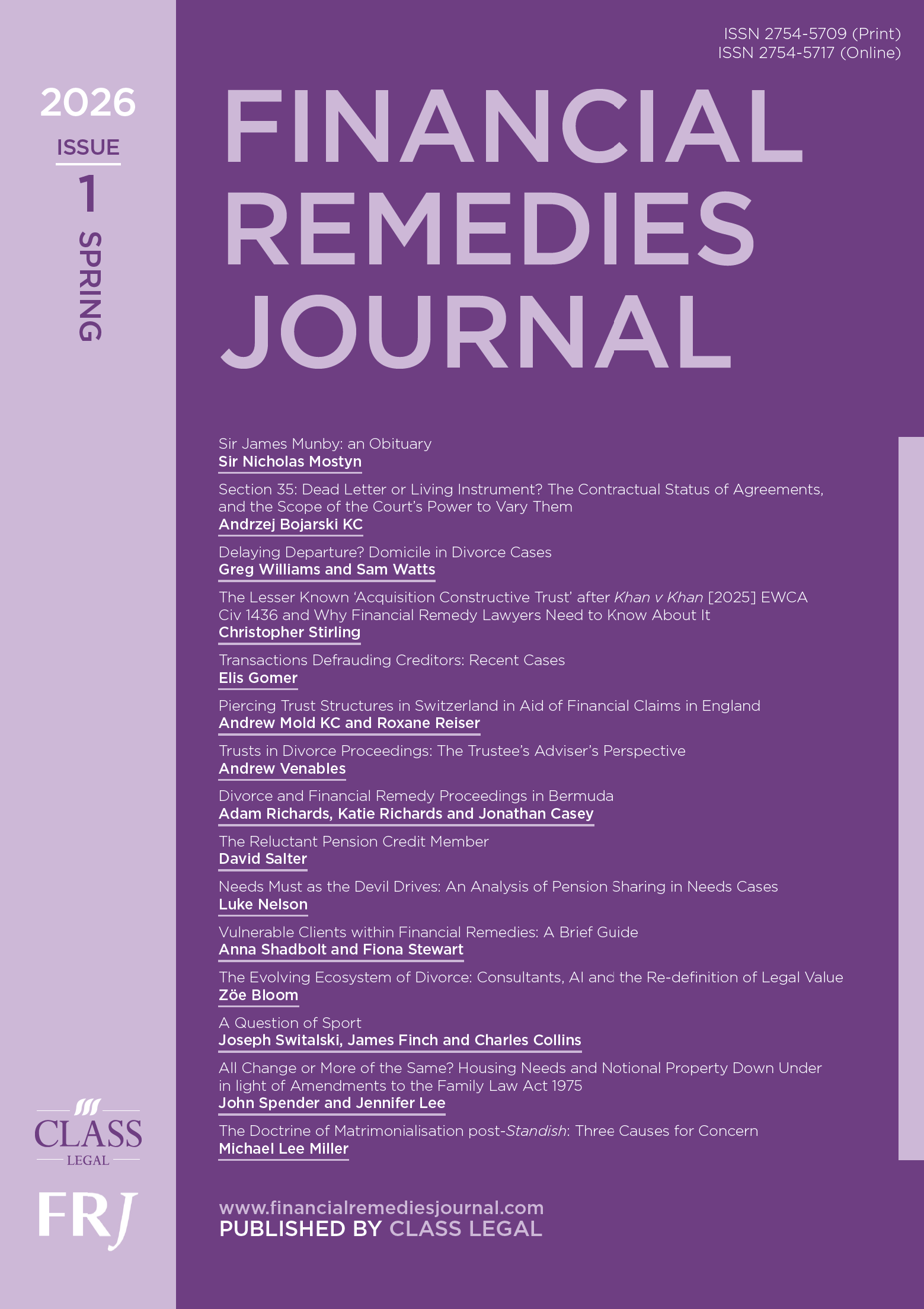
Now out: Financial Remedies Journal 2026 Issue 1 (Spring 2026)

Stop! In the Name of the LSA: Why Your Favourite Legal Exec Can’t Touch That Form A after Mazur and XX v GH