
Kars v Brown & Ors [2026] EWHC 31 (Fam)
Ms Naomi Davey (sitting as a deputy judge of the High Court). The High Court considered a claim for reasonable financial provision, brought by a former wife under the Inheritance (Provision for Family and Dependants) Act 1975.
Judgment date: 9 January 2026
https://caselaw.nationalarchives.gov.uk/ewhc/fam/2026/31
Ms Naomi Davey (sitting as a deputy judge of the High Court).
Summary
The High Court considered a claim for reasonable financial provision, brought by a former wife under the Inheritance (Provision for Family and Dependants) Act 1975.
Background
Ms Hulya Kars and Mr Jon Lamb married in 2000. Decree Absolute was pronounced on 13 May 2019. This was a long marriage of 18 years. Financial remedy proceedings were ongoing when Mr Lamb died in 2021. Hulya argued that those proceedings would have concluded but for the non-disclosure by Mr Lamb.
As a former wife, she brought a claim for reasonable financial provision under the 1975 Act against the defendants (Mr Lamb’s sons), the administrators and beneficiaries of his estate. The central dispute was over 47 Princes Street, Southend (a property which had been purchased in 2005, in Hulya’s sole legal name). The defendants argued the property belonged entirely to their father’s estate, claiming he had only put it in Hulya’s legal name for tax purposes.
The court ruled that it was necessary to first resolve this property dispute to establish the ‘net estate’.
Beneficial ownership of 47 Princes Street
Hulya argued that the property was a gift from Mr Lamb and that she was the sole legal owner, supported by the rebuttable presumption that beneficial ownership is presumed to follow the legal title.
The only evidence available from Mr Lamb himself was the content of his Form E in Financial Remedy proceedings (dated 6 February 2020), which read:
‘I provided the purchase price from my sole savings. It was vested in Hulya’s name because the family home 893 London Road (since sold) was vested in my sole name. I am the 100% beneficial owner of this property.’
The defendants argued that their father had paid for the property himself using a mortgage and a personal loan from his son, Martin. They claimed the property was only put in Hulya’s name temporarily for tax reasons (because he already owned another house) and he always intended to put it back in his own name later. Moreover, it was never Hulya’s main home, she didn't contribute to the renovations, and didn't mention the property to the benefits agency, which they said proved she knew she didn't really own it.
The court found the evidence on both sides ‘unsatisfactory’, finding that while Mr Lamb provided over 85% of the funds (via a joint account), he took no steps to place the legal title in his name for the remainder of the marriage.
Taking a holistic approach to the course of the conduct of both parties & applying principles from Stack v Dowden [2007] and Oxley v Hiscock [2005], the court found that the intention was for the beneficial ownership to be shared. Consequently, 50% of the property belonged to Hulya, and the remaining 50% fell into Mr Lamb’s estate.
The 1975 Act claim
Having dealt with the property's ownership, the court then turned to the 1975 Act.
Section 2 of the 1975 Act provides for the court to make an order if it is ‘satisfied that the disposition of a deceased’s estate is not such as to make reasonable financial provision for an applicant’.
The court applied the factors in s 3(1) of the 1975 Act as follows:
- Hulya earned a modest income as a waitress and suffered from health conditions that limited her hours. She had no savings, no private pension, and debts totalling approximately £61,000. Most critically, she lacked secure housing.
- The relationship lasted 18 years. Although Hulya moved to Manchester in 2008, the court found the marriage subsisted in some form until late 2016. Hulya had been the primary carer for their son, William, who has Asperger Syndrome.
- A significant factor under s 3(1)(g) was that Hulya had lost the chance of a financial settlement because of Mr Lamb’s death. The court also noted Mr Lamb’s history of inadequate financial disclosure during those proceedings. There being clear evidence that his son sold (in his capacity as administrator) a car belonging to Mr Lamb, which the deceased had not disclosed in his Form E.
- While there were four beneficiaries under the intestacy rules, none provided evidence of their own financial needs to the court.
The decision
The court concluded that the law of intestacy (which left Hulya with nothing) failed to make reasonable financial provision for her. To meet Hulya’s needs, specifically regarding her lack of housing, the judge ordered that the Estate’s 50% share of 47 Princes Street be transferred to her.
The court declined to award an additional £50,000 lump sum sought, ruling that once her housing was secured, her earning potential was sufficient to meet her other needs.


Latest

Beyond Thing 1 and Thing 2: Cryptoassets and the New Property Landscape
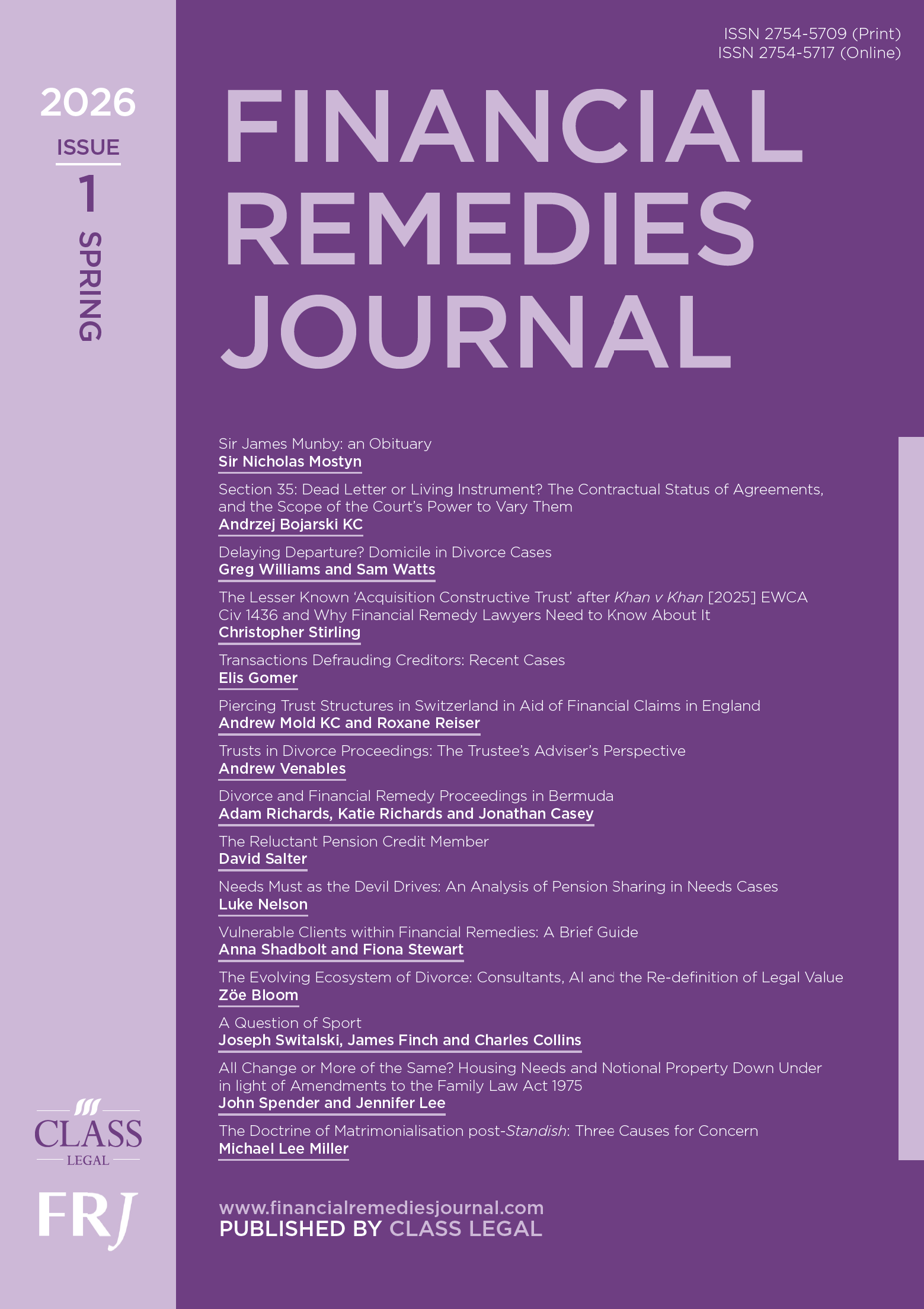
Now out: Financial Remedies Journal 2026 Issue 1 (Spring 2026)