
Money Corner: The Autumn Budget 2025 – A Summary for Divorce Lawyers
[2026] 1 FRJ 68. The Chancellor’s latest Budget landed with less drama than many feared. While the headlines confirm that income tax, VAT and NI rates remain unchanged, the detail reveals a quieter but significant shift, aimed at bringing in over £26 billion annually by 2030–31.
Autumn Budget 2025: What divorce lawyers advising high net worth clients need to know
The Chancellor’s latest Budget landed with less drama than many feared, despite weeks of conjecture about potential seismic changes to the UK tax landscape, including speculation about changes to National Insurance (NI) contributions for LLPs and vastly higher income tax rates. While the headlines confirm that income tax, VAT and NI rates remain unchanged – allowing the government to claim its manifesto pledge to avoid tax rises on ‘working people’ – the detail reveals a quieter but significant shift, aimed at bringing in over £26 billion annually by 2030–31.
Shaped by the tension between the need to tackle fiscal pressures and spending demands, while delivering a Budget for growth which didn’t cut across manifesto commitments, there were no easy choices. For high-net-worth individuals (HNWIs), fiscal drag and targeted asset-based tax increases, in particular, will shape financial planning for years to come.
Fiscal drag: the silent tax riser
Thresholds for income tax and NI will remain frozen for an additional 3 years beyond 2028. This extended freeze means more individuals will be pulled into higher and additional rate bands over time. For clients with substantial earned income, this is a slow but steady increase in liability – and a reminder that timing of bonuses, deferred remuneration and pension contributions should be reviewed carefully during divorce negotiations.
Asset-based tax increases: property, savings and dividends
The most notable changes for HNW clients are the 2% increases on property, savings and dividend income:
- Dividend tax rises from April 2026:
- ordinary rate: 10.75% (up from 8.75%)
- upper rate: 35.75% (up from 33.75%)
- additional rate remains at 39.35%
- Savings income tax rises from April 2027:
- basic rate: 22%
- higher rate: 42%
- additional rate: 47%
- Property income will have its own banded rates from April 2027:
- basic rate: 22%
- higher rate: 42%
- additional rate: 47%
For clients with investment portfolios or rental property, these changes will bite. The government’s stated aim is to narrow the gap between tax on work and tax on wealth – a theme that divorce lawyers should anticipate in settlement discussions, particularly where income streams are asset-based.
Interestingly, readers will also notice that the increase for income tax on dividends has not been applied to the additional rate of tax, only the basic rate and higher rates, whereas the increase for savings and property income applies across all tax bandings.
Mansion tax – mild but material
The much-discussed ‘mansion tax’ emerged as a council tax surcharge of £2,500–£7,500 for properties valued over £2m from 2028/29. While less severe than feared, this will still affect clients with prime property holdings. For those negotiating property division, factoring in future council tax liabilities is prudent.
Pensions and salary sacrifice
From April 2029, NI will apply to salary sacrifice pension contributions above £2,000. Contributions above this threshold will attract employer NI (currently 15%) and employee NI at standard rates (currently 8% or 2% depending on earnings). This could reduce the attractiveness of certain pension funding strategies often used in financial remedy cases. Employers will need to review their approach to pension salary sacrifice arrangements, and there will be knock-on effects for those who offer employees the ability to waive bonuses into pensions.
Capital gains tax and business relief
No headline capital gains tax rate changes, but restrictions on relief for disposals into Employee Ownership Trusts were announced. For entrepreneurial clients considering succession planning during divorce, this is a key detail.
Inheritance tax – stability for now
Nil-rate bands and reliefs remain frozen until at least 2031. While stability is welcome, the freeze means more estates will drift into chargeable territory over time – another example of fiscal drag.
What about agricultural property relief and business property relief?
Many will recall that at Autumn Budget 2024, the government announced that, from April 2026, the availability of 100% relief for agricultural and business property would be capped. Assets eligible for 100% agricultural property relief and assets eligible for 100% business property relief would qualify for full relief up to a sum of £1m, with 50% relief applying thereafter.
At Autumn Budget 2025, the government partially amended its original proposals and announced that the allowance would become transferable between spouses and civil partners, which has been widely welcomed. This is in line with the nil-rate band and residence nil-rate band.
What some may not have realised, in the lead-up to Christmas and the impending festivities, is that on 23 December 2025, the government further announced that the allowance would increase from £1m to £2.5m per estate. This increase in the tax-free allowance to £2.5m, and the allowance being transferable between spouses and civil partners, will significantly reduce, or in some cases eliminate, the tax burden for family farms.
In practice, this means that a spouse/civil partner who receives £2.5m of agricultural assets from their deceased spouse/civil partner will be able to utilise tax-free allowances of up to £5m – £2.5m from their partner and £2.5m of their own – when passing assets to their children.
Practical takeaways for divorce lawyers
(1) Review asset structures – increased taxation on property, savings and dividends means settlements relying on passive income may need recalibration.
(2) Consider timing – with phased implementation dates (2026–29), timing of disposals, pension contributions and income crystallisation could materially affect net outcomes.
(3) Factor in future liabilities – mansion tax surcharges and frozen thresholds will impact affordability and cash flow for clients retaining high-value homes.
(4) Advise on liquidity – higher tax on investment income may push clients towards share-based investments or alternative strategies; ensure liquidity for maintenance obligations.
The Autumn Budget may not have delivered the shock some anticipated, but its quiet complexity demands attention. For HNW clients navigating divorce, these changes underscore the need for proactive tax planning alongside financial remedy advice.
Related
Chair’s Column (Spring 2026)

Sir James Munby: an Obituary
Section 35: Dead Letter or Living Instrument? The Contractual Status of Agreements, and the Scope of the Court’s Power to Vary Them


Related
Chair’s Column (Spring 2026)
Sir James Munby: an Obituary
Section 35: Dead Letter or Living Instrument? The Contractual Status of Agreements, and the Scope of the Court’s Power to Vary Them
Latest
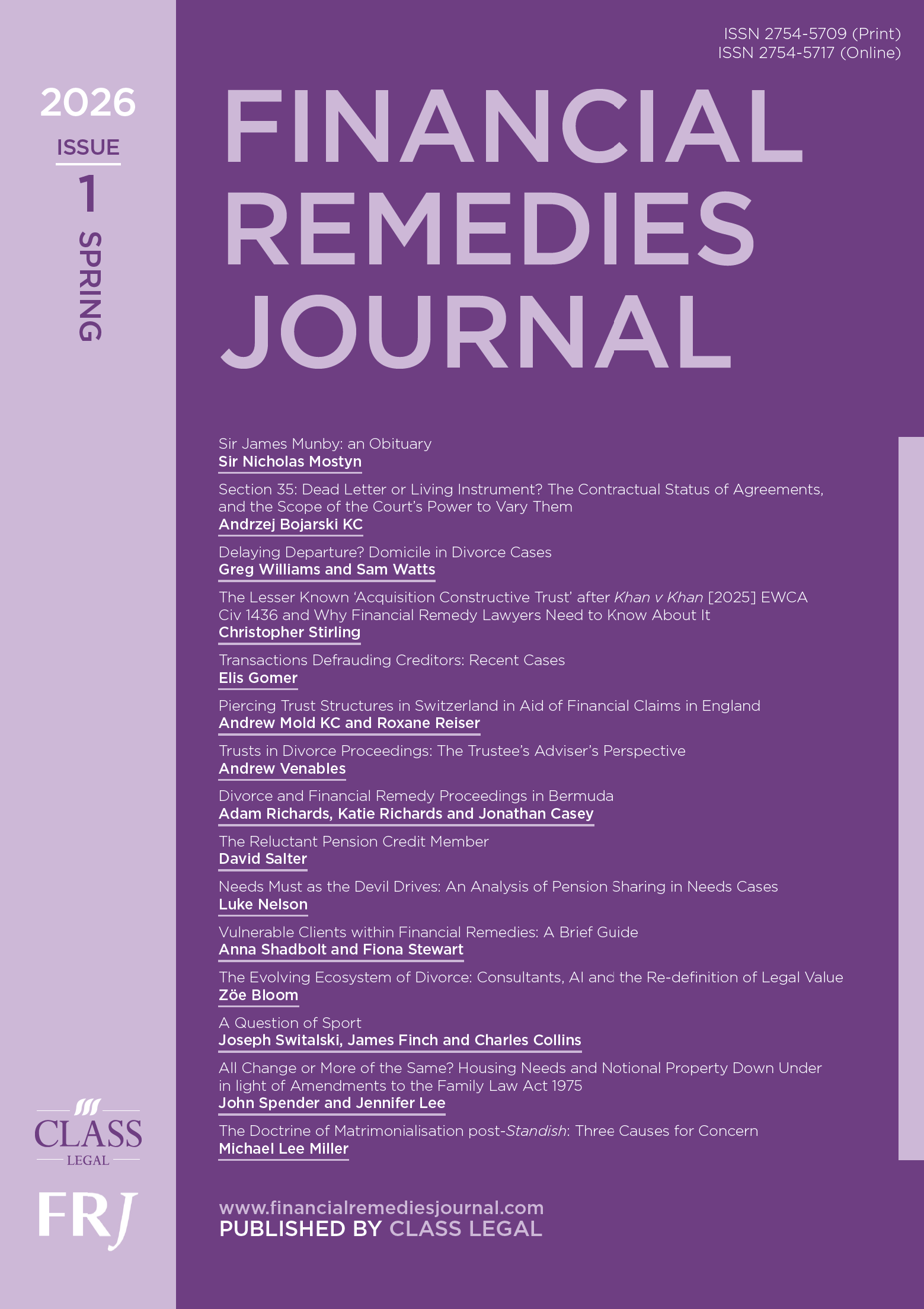
Now out: Financial Remedies Journal 2026 Issue 1 (Spring 2026)

Stop! In the Name of the LSA: Why Your Favourite Legal Exec Can’t Touch That Form A after Mazur and XX v GH