
Now out: Financial Remedies Journal 2026 Issue 1 (Spring 2026)
The new issue of the Financial Remedies Journal is now available.
Links to individual articles in the issue are below.
Chair’s Column (Spring 2026) [2026] 1 FRJ 1 – HHJ Edward Hess. HHJ Edward Hess says farewell to Sir James Munby: 'the most inspirational figure I have come across in my legal and judicial career'.
Sir James Munby: An Obituary [2026] 1 FRJ 2 – Sir Nicholas Mostyn. Sir Nicholas Mostyn writes about the life of Sir James Munby, who died on 1 January 2026: 'a great leader, a brilliant historian, a remarkable lawyer, and a superb writer'.
Section 35: Dead Letter or Living Instrument? The Contractual Status of Agreements, and the Scope of the Court’s Power to Vary Them [2026] 1 FRJ 5 – Andrzej Bojarski KC. This article reviews the legal status of agreements made between spouses, including their enforceability as actionable contracts, and the importance of the powers the courts have to vary or revoke such agreements.
Delaying Departure? Domicile in Divorce Cases [2026] 1 FRJ 16 – Greg Williams and Sam Watts. In Ramana v Kist Ramana [2025] EWCA Civ 1022, [2025] 4 WLR 120 the Court of Appeal was concerned with the question of how a domicile of choice may be lost. This article explores the arguments made at the hearing, the court’s decision and reasoning, and the likely implications of its outcome.
The Lesser Known ‘Acquisition Constructive Trust’ after Khan v Khan [2025] EWCA Civ 1436 and Why Financial Remedy Lawyers Need to Know About It [2026] 1 FRJ 19 – Christopher Stirling. When thinking of constructive trusts, most financial remedy lawyers will have in mind the common intention constructive trust. However, this is not the only type of constructive trust. The newly christened ‘acquisition constructive trust’ is one with which we should all become familiar.
Transactions Defrauding Creditors: Recent Cases [2026] 1 FRJ 23 – Elis Gomer. This article examines the nature of the Insolvency Act 1986 s 423 jurisdiction, its parameters and its practical application, as seen in the judgment of Harrison J in the Schedule 1 case of Re P (A Child) (Financial Provision: s 423 Insolvency Act 1986) [2025] EWHC 1460 (Fam).
Piercing Trust Structures in Switzerland in Aid of Financial Claims in England [2026] 1 FRJ 26 – Andrew Mold KC and Roxane Reiser. Swiss courts possess domestic tools to pierce through foreign trust structures and make orders in respect of their underlying assets. This article examines what those tools are and how they may be deployed in aid of financial remedies proceedings in England.
Trusts in Divorce Proceedings: The Trustee’s Adviser’s Perspective [2026] 1 FRJ 30 – Andrew Venables. This article aims to provide a perspective on trusts within English financial remedy proceedings, from the perspective of trustees and law firms in Jersey. These days, the view of offshore trusts as a vehicle for hiding assets from authorities, creditors and spouses is unlikely to be true.
Divorce and Financial Remedy Proceedings in Bermuda [2026] 1 FRJ 35 – Adam Richards, Katie Richards and Jonathan Casey. Bermuda has a large expatriate community, with many guest workers on time-limited contracts, so family disputes often involve difficult jurisdictional questions, including the appropriate forum for divorce and a high number of applications for permission to remove children from the jurisdiction.
The Reluctant Pension Credit Member [2026] 1 FRJ 39 – David Salter. In the case of AP v TP [2025] EWFC 190 (B) a financial remedy order was made by consent, following an FDR, which included a pension sharing order in W’s favour. Difficulties began when W failed to provide the necessary information to Aviva to permit the pension share to be implemented.
Needs Must as the Devil Drives: An Analysis of Pension Sharing in Needs Cases [2026] 1 FRJ 43 – Luke Nelson. Despite PAG1 and W v H [2020] EWFC B10 stressing the importance of treating a case on its own facts, somehow a view developed that pensions should inevitably be divided to achieve equality of income in all ‘needs’ cases. Where this came from isn't clear, but it’s worth starting with PAG1.
Vulnerable Clients within Financial Remedies: A Brief Guide [2026] 1 FRJ 47 – Anna Shadbolt and Fiona Stewart. Practitioners in the financial remedies field need to be aware of the impact of vulnerability on a party’s ability to participate in proceedings and to give evidence, the mechanism for addressing this and the potential harm of not doing so. This article provides a concise guide.
The Evolving Ecosystem of Divorce: Consultants, AI and the Re-definition of Legal Value [2026] 1 FRJ 50 – Zöe Bloom. Growing resistance to billing models that reward time spent rather than judgment exercised, AI and the normalisation of divorce consultants have reshaped the divorce landscape. If support, information and drafting can be accessed elsewhere, what are clients paying for when they instruct a solicitor?
A Question of Sport [2026] 1 FRJ 52 – Joseph Switalski, James Finch and Charles Collins. 1990. Karen Richardson is 22 years old and meets her future husband, Ray Parlour. Ray is 19 and signed his first professional contract with Arsenal less than 12 months ago. Football, as culturally significant then as it is now, was about to change beyond all measure.
All Change or More of the Same? Housing Needs and Notional Property Down Under in light of Amendments to the Family Law Act 1975 [2026] 1 FRJ 55 – John Spender and Jennifer Lee. This article considers two aspects of the 2025 amendments to the Australian Family Law Act 1975: the greater recognition given to the needs of a party who has the care of a child to provide housing, and the removal of notional property or addbacks in the balance sheet in property division matters.
The Doctrine of Matrimonialisation post-Standish: Three Causes for Concern [2026] 1 FRJ 61 – Michael Lee Miller. The Supreme Court decision in Standish v Standish has significantly clarified the law of matrimonialisation – the circumstances under which property that is presumed to fall outside the bounds of the marital partnership is deemed matrimonial for the purposes of financial remedies applications.
Money Corner: The Autumn Budget 2025 – A Summary for Divorce Lawyers [2026] 1 FRJ 68 – Jennifer Lee and Roger Isaacs. The Chancellor’s latest Budget landed with less drama than many feared. While the headlines confirm that income tax, VAT and NI rates remain unchanged, the detail reveals a quieter but significant shift, aimed at bringing in over £26 billion annually by 2030–31.
DR Corner: Arbitration, Litigation and Biscuits [2026] 1 FRJ 70 – Max Lewis. A member of the author's chambers once described the private FDR as a court FDR, with biscuits. But arbitration and litigation are also different in other important ways, and arbitration is not just another form of consensual non-court dispute resolution (NCDR).
Book Review: Financial Remedies Handbook 2025 [2026] 1 FRJ 74 – Rhys Taylor. A review of the 15th edition of Financial Remedies Handbook 2026, by District Judge Sophie Harrison, published by LexisNexis.
Important Recent Case Developments (Mid-September 2025 to mid-January 2026) [2026] 1 FRJ 76 – Polly Morgan. Noteworthy case law developments since the last issue went to press in the early autumn. Not all of them are citable as precedent, but they are all informative and a good demonstration of the cases being heard up and down the country.
The Summary of the Summaries (Spring 2026) [2026] 1 FRJ 79 – Liam Kelly. Summaries of cases including AT v NB (No 2) [2025] EWFC 287 (B), Re H [2025] EWHC 2361 (Fam), G v N [2025] EWFC 286 (B), and KU v BI [2025] EWFC 296 (B).
Interview with Lady Justice King [2026] 1 FRJ 82 – Samantha Hillas KC. An interview with a female trailblazer, who has been at the coalface of financial remedies work during a career so far spanning almost half a century, about her journey to the Bar, her judicial appointments and the swingeing changes in practice that she has witnessed along the way.


Latest
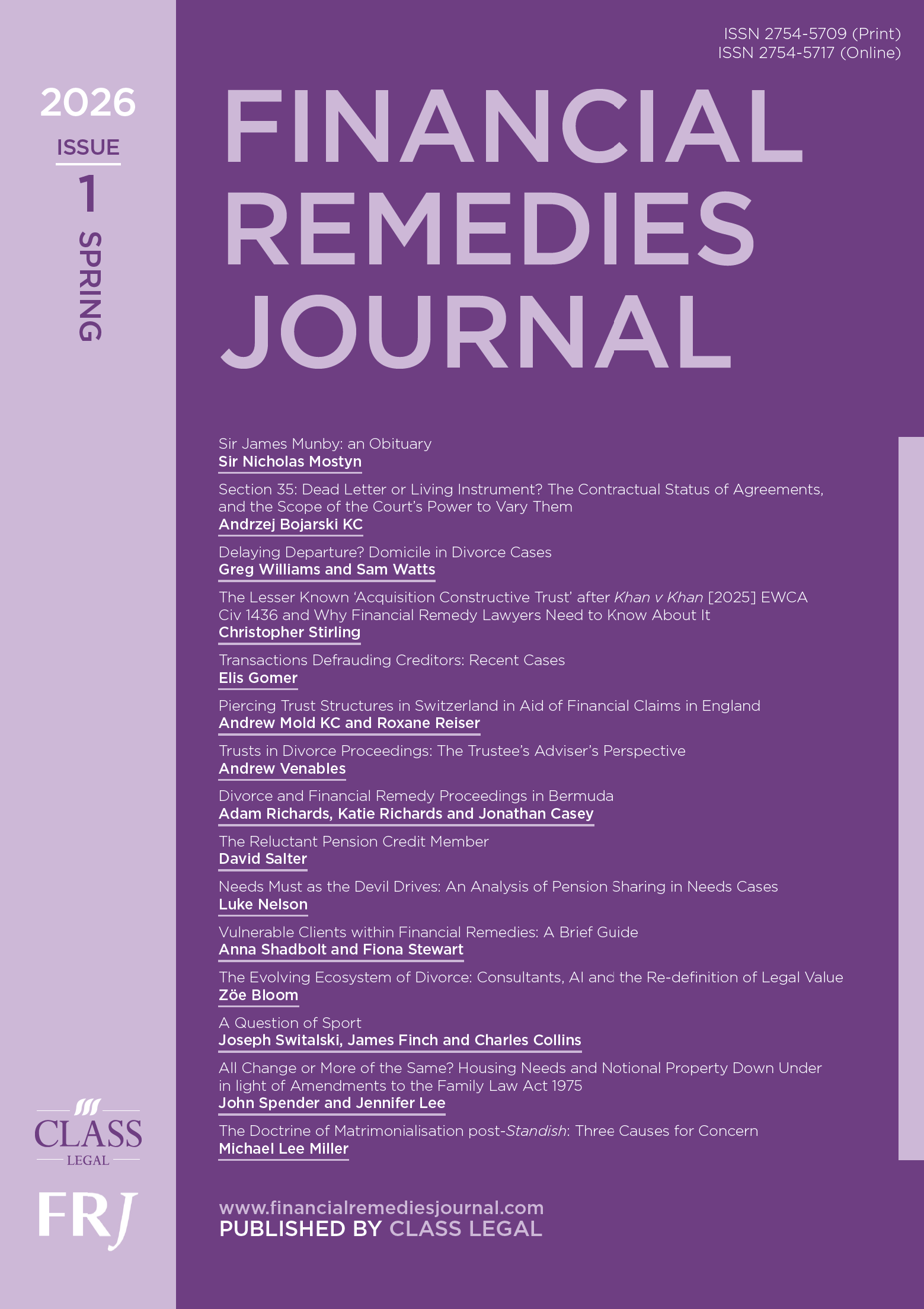
Now out: Financial Remedies Journal 2026 Issue 1 (Spring 2026)

Stop! In the Name of the LSA: Why Your Favourite Legal Exec Can’t Touch That Form A after Mazur and XX v GH