
The Doctrine of Matrimonialisation post-Standish: Three Causes for Concern
[2026] 1 FRJ 61. The Supreme Court decision in Standish has significantly clarified the law of matrimonialisation – the circumstances under which property that is presumed to fall outside the bounds of the marital partnership is deemed matrimonial for the purposes of financial remedies applications.
The Supreme Court’s decision in Standish v Standish[[1]] has significantly clarified the law of matrimonialisation – the circumstances under which property that is presumed to fall outside the bounds of the marital partnership is deemed matrimonial for the purposes of financial remedies applications. The clarification afforded is that non-matrimonial assets can never be subject to the ‘sharing principle’ laid down in White v White,[[2]] thereby extinguishing a lingering question posed in Charman v Charman (No 4)[[3]] as to the possibility, however remote, that such assets could ever be used to do more than meet the divorcing parties’ post-marital needs. The court has therefore moved the law in the direction of doctrinal clarity and so legal certainty – an essential aspect of the rule of law. Further, it has shifted the entire conceptual framework in which matrimonialisation is to be approached away from ‘mixing’ or ‘mingling’, towards ‘sharing’ or ‘the parties’ dealings over time’. At first sight, this new method offers greater scope for providing financial remedies in a way that accords better with the reasonable expectations of the parties.
However, the law as it now stands is deeply dissatisfactory, for three reasons. First, the Supreme Court’s reasoning has introduced an artificial restriction. Although we have been provided with a more versatile and compelling account of matrimonialisation than ‘mixing’, which is the approach that has prevailed up to now, the notion of ‘sharing’ that has replaced it is too narrowly construed. Matrimonialisation has been starkly, and seemingly arbitrarily, limited to only one of two conceivable species of sharing, ‘amenity’ to the exclusion of ‘responsibility’. It is submitted that both species of ‘sharing’ should be available to parties to persuade the court that an asset has been matrimonialised. I will work through this distinction in the first section.
Second, despite having delineated the concept of ‘sharing’ narrowly, the Supreme Court has left unexamined the requisite intention to matrimonialise. Its language wavers between a joint intention between the parties – implying something similar to what we find in a common intention constructive trust – and an individual intention on the side of the owner to contribute the non-matrimonial property towards the marital partnership. Thus, the aims of strengthening legal certainty and respecting the reasonable expectations of the parties have been frustrated: as we shall see, even on a restrictive understanding of ‘sharing’, it is impossible to make a principled finding without a clear test as to the underlying intention to matrimonialise. This issue will be explored in the second section.
Third, and perhaps most decisively, the new doctrine is not capable of securing one of the basic aims of the law of matrimonialisation. For although the implicit intention behind the court’s approach has been to safeguard non-matrimonial assets from encroachment, by imposing what are in fact stringent requirements for matrimonialisation, it fails to provide a principled basis for acknowledging degrees of relevance or proximity to the marital partnership among the assets that are thereby excluded from the matrimonial pot. Thus, where the court must go beyond the pot to achieve a fair outcome[[4]] it has no basis for discriminating in a principled way among non-matrimonial assets. The implications of, and alternatives to, that scenario will be explored in the third and final section.
Amenity, responsibility and the meaning of ‘sharing’
In [52] of their judgment, Lord Burrows and Lord Stephens (with whom the other justices agreed) state:
‘Although this has not previously been clearly spelt out, what is important … is to consider how the parties have been dealing with the asset and whether this shows that, over time, they have been treating the asset as shared between them. That is, matrimonialisation rests on the parties, over time, treating the asset as shared.’
Likewise in [54] the court states that ‘it is the parties’ treatment of what was initially non-matrimonial property, over time, as shared between them, that is central in deciding the fairness of that property being viewed as matrimonialised’. Between these two dicta, in [53], we are given a quotation from Duckworth’s Matrimonial Finance and Property (the court ‘agree[s] with the essential thrust’): ‘matrimonial property … is governed by the parties’ intentions and how they treat the relevant asset over a period of time’. Three iterations of the same idea – here we have the leitmotif of the new doctrine of matrimonialisation that will now be deployed in English financial remedies proceedings.
However, the quotation from Duckworth is not confined to the idea of the parties’ treatment of the asset over time. It goes on to specify that matrimonialisation depends on the contributing party ‘demonstrat[ing] an intention to use an inheritance for the benefit of the family’.[[5]] Taken at face value, already we can see that there is a question around the requisite intention: the reference to the contributor ‘demonstrating an intention’ is taken to imply that ‘the parties have elected to treat it’ as matrimonial property. There is real slippage here, from the contributor’s intention to the parties’ intention – I will deal with this below. First, we need to focus in on the idea of ‘using an inheritance for the benefit of the family’. This is key, for although it is not made explicit it seems unavoidable that the court has based its decision on a specific conception of the kind of sharing that must be evidenced – namely the sharing of amenity (i.e. benefit, use).
The language of ‘benefit’ appears in the Duckworth quotation but is otherwise absent from the judgment. However, it becomes difficult to explain the ratio without inferring that in speaking of ‘sharing’ (for the purposes of matrimonialisation) the operative notion is limited to the sharing of benefit, or amenity. Because the wife (W) was only supposed to hold the ‘2017 assets’ for the purposes of saving inheritance tax – by eventually settling the assets into Jersey trusts – the court found (in [56]) that there was no ‘sharing’ of the assets in a manner relevant for the purposes of matrimonialisation:
‘In relation to a scheme designed to save tax, under which one spouse transfers an asset to the other spouse, the parties’ dealings with the asset, irrespective of the time period involved, do not normally show that the asset is being treated as shared between them. Rather the intention is simply to save tax … transfers of capital assets with the intention of saving tax, do not, without some further compelling evidence, establish that the parties are treating the capital asset as shared between them.’
The implication is that the parties’ dealings do not amount to ‘sharing’ even though W was to assume full responsibility for the assets until such time as they would be transferred into offshore trusts, and even though through the tax saving scheme the latent value of the assets was to increase to the benefit of the children of the marriage.[[6]] What is missing, in other words, is personal benefit to W: she was never to derive any amenity from the assets.
If a long-term tax saving scheme intended to benefit the children of the marriage and predicated on the assumption of responsibility by the non-contributing spouse is insufficient to matrimonialise an asset, it can only be because the ‘sharing’ involves no benefit to that spouse. To avoid that conclusion, an alternative explanation for the court’s judgment would have to be found – and it is not at all clear what that could be.[[7]]
This is, in fact, a novel approach to the doctrine of matrimonialisation. As stated at the outset, prior to Standish, the doctrine of matrimonialisation has been reliant on a notion of ‘mixing’, an emphasis exemplified by Wilson LJ (as he then was) in Jones v Jones and K v L (Non-matrimonial Property), by Mostyn J in N v F (Financial Orders: Pre-Acquired Wealth), and by Moylan LJ in a number of judgments to which I will turn shortly.[[8]] However, at no point has the law arrived at a consolidated consensus as to precisely what method should be employed to resolve questions of ‘mixing’.[[9]]
Roberts J’s judgment in WX v HX (NX and Another Intervening) (Treatment of Matrimonial and Non-matrimonial Property), the most recent of the significant pre-Standish cases, offers a variation of the ‘mixing’ doctrine that, as we shall see in due course, is important for understanding the limitations of the new, post-Standish position, as well as the missed opportunity.[[10]] At [134] we read:
‘I recognise that the extraction of the shares and the loss of the discount to underlying value produced an immediate uplift in the paper value of the funds. This does not, in my judgment, amount to a conversion of these funds from non-matrimonial to matrimonial property. This is not in any way to diminish H’s contribution as the steward over many years of W’s separate wealth … I cannot on the evidence available conduct a reliable trace which produces significant uplift into the present value of W’s non-matrimonial funds on that basis alone.’
Roberts J seems to have approached the issue as follows: where (1) the non-contributing party takes responsibility for an asset and (2) the court finds that the non-contributor’s assumption of responsibility has led to a real appreciation in that asset’s value then that asset may be matrimonialised, in part or fully. This is entirely logical: after all, the present value is at least partly matrimonial in the sense that the value-add has been generated by one of the spouses in the course of the marriage. Presumably, partial matrimonialisation will be found where the court can point to a specific margin of growth that is directly attributable to the non-contributor. However, the taking of responsibility alone is insufficient to matrimonialise. If it were, WX v HX would have had to be decided differently.
Roberts J cited (without explicit approval) passages from two judgments by Moylan LJ, Hart v Hart and XW v XH (Financial Remedies: Business Assets), which along with his judgment in C v C exemplify his method of dealing with ‘mixing’.[[11]] In this approach, if the court finds that an asset is ‘mixed’ then for the purposes of the computational stage the entire asset will effectively be deemed matrimonial and then the court will exercise its discretion to reflect the non-matrimonial component, via a departure from the White v White ‘sharing principle.’[[12]] Here, mixing itself is sufficient for the non-matrimonial asset to be matrimonialised. It has become simply matrimonial: the non-matrimonial source of (some of) the value becomes an argument for the court to depart from the presumption of equal division. Conversely, the court may find that the asset should be delineated between its constitutive parts considered in their origin: the non-matrimonial part remains non-matrimonial.
Despite taking her bearings from Moylan LJ, the method deployed by Roberts LJ in WX v HX gives us something different. It addresses the issue of what is matrimonial at the computational stage: the court should go on to apply the White v White ‘sharing principle’ as it normally would, an exercise that presupposes a secure assessment of the (specifically) matrimonial asset base. It also brings the issue of the assumption of responsibility by the non-contributor into the picture – a point of significance for the purposes of critiquing Standish (more on this shortly). But ultimately it too leaves us with a doctrine of matrimonialisation that depends on a finding of ‘mixing’. The assumption of responsibility can matrimonialise provided it results in a value-add in respect of the asset in question, which in turn allows the court either to hive off that additional value as matrimonial or else to declare the entire asset matrimonialised. (The latter seems unlikely unless the circumstances of the case are such that it is impossible to make any secure determination as to what residual ‘non-matrimonial’ value is present in the asset.)
Before teasing out the potential latent in this approach, let us pause to note how much of a shift the Supreme Court’s reasoning in Standish represents. Most obviously, no adjudication on the merits of each of the ‘mixing’ approaches has been made – and this might have been expected. Conversely, the law has not been overturned. Instead, it has been moved onto a deeper and, at least in terms of its intended aim, a more versatile conceptual foundation. The court in [54] makes clear that the new approach encompasses and goes beyond the doctrine laid down by Wilson LJ in K v L.[[13]]
The Supreme Court’s approach to K v L was to get behind ‘mixing’ as an explanation for why the law has been willing to deem assets matrimonialised in specific circumstances. It has delved deeper, and identified ‘sharing’ as the more fundamental principle. It is not the case that ‘mixing’ is now irrelevant. Rather, the point is that where there is no ‘mixing’ that does not mean there is no matrimonialisation. Conversely, the presence of ‘mixing’ does not imply that the contributing spouse will necessarily retain a non-matrimonial interest. For instance, let us say that an inheritance windfall is contributed towards the purchase of a yacht, and the yacht is treated as shared between the spouses over the course of the marriage. It is difficult to see how now (post-Standish) the spouse contributing the inheritance windfall could argue that they retain a separate, non-matrimonial interest in the yacht proportionate to the contribution. My view is that in this sort of case, the new position accords better with the parties’ reasonable expectations. Some practitioners may disagree. In the converse situation, namely where sharing cannot be made out on the facts, ‘mixing’ will still have conceptual weight: it will serve to explain why the relevant spouse does retain a non-matrimonial interest.[[14]]
So much for the fate of ‘mixing’. I suggest, however, that while the Supreme Court’s broad reorientation of the law is correct in principle, the new foundation is not as versatile as it is supposed to be. The law as it now stands is capable of producing an ‘unfair’[[15]] or indeed unconscionable result. Let us return to WX v HX. We have seen that Roberts J was open to the idea that an assumption of responsibility for a non-matrimonial asset by the non-contributor could lead to matrimonialisation of that asset, provided the asset’s final value reflected a ‘mixing’ of non-matrimonial and matrimonial value.[[16]] The Supreme Court could have taken forward this line of thinking, only dispensing with the second step of identifying a ‘mixing’ in the final value.
There are two reasons why that would have made sense as a way to move the law in the desired direction. First, and most obviously, the court was prepared to dispense with the focus on ‘mixing’ that has previously dominated – I believe correctly. Once the need to show ‘mixing’ is excluded, it seems difficult to avoid concluding that WX v HX should have been decided differently. Second, if the assumption of responsibility is itself sufficient to open up the possibility of matrimonialisation – as Roberts J held – it is unclear why value-add should be a relevant consideration. Not all assets appreciate in value, at least not in the way investment portfolios are supposed to. Depreciation can also be an issue: the preservation of value may be just as important in shaping the parties’ dealings – I will offer an illustration of this shortly.
The point I wish to make is that had the Supreme Court adopted WX v HX as its starting point, it could have adopted a more expansive notion of ‘sharing’ encompassing not only amenity but also responsibility, whilst retaining its emphasis on the central role played by the parties’ dealings with the asset over time and leaving aside the emphasis on ‘mixing’.
In this approach, the court would not be focussed solely on whether the parties’ dealings over time show that they treated it as shared in respect of amenity. Instead, the court would additionally consider whether the parties’ settled dealings with the non-matrimonial asset evidence a shared concern for its preservation, upkeep or safeguarding. Crucially, such a finding would not be dependent on the final value of the asset, which may or may not reflect an identifiable margin of value-add traceable to the non-contributor’s conduct – that being Roberts J’s method in WX v HX. Transfers of capital assets that simply by operation of law reduce the latent tax liability on that asset (either capital gains tax or inheritance tax) would therefore fall within the scope of matrimonialisation, provided the court could be satisfied that the transfer involved a sharing of responsibility for the asset by the parties over time.
To illustrate the difference between the narrow and expansive notions of sharing just outlined, we may consider the following example. W comes from an equestrian family, and as a marriage gift receives a successful ex-racer stallion from her father. H does not really like being around horses and does not ride. However, H is the primary earner and pays all veterinary bills, buys feed, when necessary covers livery and grooming. Sometimes he also helps W tend the horse, in particular mucking out the stall. At the time of the divorce, the horse is expected to be sold and put out to stud, and due to his career, pedigree and good health is expected to sell very well at auction.
Is the horse a matrimonialised asset? At this juncture, the answer seems to be a decisive ‘no’. There is nothing in the parties’ dealings with the horse to suggest that they have treated it as shared in respect of amenity. In fact, the only difference between this case and Standish – other than the fact that here the asset is tangible, there intangible – is that here the parties’ dealings include the non-contributor taking responsibility through voluntary monetary expenditure, rather than through the voluntary assumption of legal title or, for that matter, fiduciary duties.[[17]]
I suggest – and I suspect many practitioners would agree – that this is an unconscionable outcome given H’s contribution to the upkeep of the horse. Without his significant financial outlay over the years, the horse may well have died prematurely, or at the very least suffered medical complications impacting its value at auction. H’s contribution directly translates into the preservation of the value of a key family asset, and this should be recognised by the court in determining the issue of matrimonialisation. H shared via responsibility, not amenity.
The intention to matrimonialise
An essential component of the rule of law is legal certainty, and an essential component of legal certainty is clearly articulated principles. Tests are one of the ways the law articulates its principles. The test for matrimonialisation must necessarily include reference to the requisite mode of sharing, but it cannot be limited to that. The case law preceding Standish – when the doctrine of matrimonialisation was still governed by the emphasis on ‘mixing’ – included an additional concern with intention, specifically on the part of the spouse who (purportedly) contributes the non-matrimonial property. The question arises, then, what has become of this aspect of the doctrine post-Standish. As we will see, there is not an unambiguous answer. But insofar as the probable answer can be gleamed from the judgment, we have yet another cause for concern.
The condensed nature of ratio does not permit us to disentangle cleanly the question of the scope of ‘sharing’ from that of the requisite intention. As discussed already, the court ([56]) based its decision on a finding that the parties’ treatment of the relevant assets did not manifest an intention for W personally to derive any benefit from those assets, i.e. to ‘share’ them in a matrimonialising way. Where tax saving is the purpose of the parties’ dealings, then ‘irrespective of the time period involved’ those dealings will not amount to ‘sharing’ since the ‘intention’ to be inferred from the dealings is ‘simply to save tax’ – including where the benefit from the tax saving will flow to the children of the marriage.
Although we are not given much to go on, some reasonably secure inferences as to the requisite intention can be extracted. First, the object of the intention must be the sharing of some amenity or benefit: it is a species of ‘sharing’ which the intention must concern, and as should be clear already the Supreme Court has limited the scope of such sharing to amenity. Indeed, by saying ‘irrespective of the time period involved’ the court is emphasising that a responsibility-based sharing will be insufficient even if it is long-term. That leads to a second component of the requisite intention: even where there is an intention to engage in the sharing of amenity, that intention cannot be short-term or episodic. This is directly stated in [52]: ‘the period of time must be sufficiently long for the parties’ treatment of the asset as shared to be regarded as settled’.
Yet it is unclear here whether the putative intention to share would have been H’s alone, or rather that of both H and W together. References to the parties’ ‘dealings with the asset’ or ‘treating it as shared between them’ suggest an inference of common intention from joint conduct. This is hardly a novelty for practitioners. It is what we find in cases of common intention constructive trust – the convergence here has been noted often since the judgment was handed down.
In fact, other parallels between matrimonialisation and such common intention trusts present themselves. For instance, although the law has not been couched in these terms thus far, there is a sense in which to argue successfully for matrimonialisation involves rebutting a presumption that certain assets are non-matrimonial and therefore not subject to the White v White ‘sharing principle’ (just as common intention constructive trust involves displacing a presumption that beneficial ownership follows legal title). The key difference is that whereas a common intention trust relies on detrimental reliance to secure the necessary ‘unconscionability’ – necessary to afford the claimant a claim on the asset where they otherwise would not – in matrimonialisation the marital partnership itself does that work. Accordingly, the doctrine of matrimonialisation would enjoy a great deal of certainty if it were to run in parallel to the common intention constructive trust, which is settled law, on the issue of intention.
However, that is probably not where things stand. Returning to the ratio in Standish, the quotation from Duckworth leaves open the possibility that it was specifically H’s intention as the contributor of the non-matrimonial assets that mattered: the contributing party must have ‘demonstrated an intention to use an inheritance for the benefit of the family’.[[18]] Not only that, but in [52] we are referred to K v L ([18]), where in laying out his formulation of matrimonialisation via ‘mixing’ Wilson LJ spoke of ‘the acceptance by the contributor that the asset should be treated as matrimonial property’.[[19]] In this connection, the court also points to Mostyn J’s judgment in N v F ([44]).[[20]] It should be noted that a somewhat more elaborate version of this same test was used by Roberts J in WX v HX ([117]), ostensibly relying on K v L.[[21]]
On balance, by virtue of its references to the judgments of Wilson LJ and Mostyn J, both of which speak of the contributor’s ‘acceptance’, it seems probable that the Supreme Court prefers this latter version of matrimonialisation intention. The court’s reasoning thus represents a convergence of (a) a restrictive notion of ‘sharing’ via amenity with (b) a restrictive notion of intention, in which the contributor must signal an ‘acceptance’ of the sharing and an inference from joint conduct will be insufficient.
Yet precisely because the court had already effectively decided the issue with its stance on ‘sharing’, it did not need to tackle the question of intention head-on. By limiting the scope of ‘sharing’ to amenity, it had already decided the case. We are left with either a clear test that is highly restrictive and likely to lead to unconscionable outcomes – I shall illustrate this shortly – or else an amorphous test that perpetuates the uncertainty which plagues financial remedies work. Is it the contributor’s (sole) intention to ‘benefit the family’ or to ‘accept the sharing’ as manifested through ‘words, actions or deeds’ that is decisive? Or is it the parties’ common intention to treat the property as shared as manifested through their dealings with it over time? Both possibilities remain on the table.
Despite this equivocation, there is a species of intention that has been ruled out by Standish, namely an intention (either sole or common between the spouses) for a non-matrimonial asset to benefit the children of the marriage but specifically not the non-contributing spouse. That must be excluded: not only would such an intention stretch the meaning of the word ‘sharing’ (on an amenity basis), but in addition it would also mean that transfers of cash from one spouse to another for expenditures such as school fees would be sufficient to matrimonialise the cash. That cannot be right.
Let us return to our example of the horse. Following Standish, H is confined to arguing for matrimonialisation by way of amenity-based sharing. He will need to argue that his contribution towards the animal’s upkeep, and W’s acceptance of that contribution over the course of the marriage, evidences a common intention on the part of the marital partnership for the family to benefit via the proceeds of its eventual sale. H could argue that this had always been the plan, at least implicitly, given the characteristics of the horse (namely pedigree, racing career and so on). W could deny the inference of common intention from their collaborative care of the animal: she never intended for anyone to derive any benefit from the horse except herself. Although she has been happy to accept H’s generosity in paying vet bills and in mucking out the stable, and although it was common ground that the horse would eventually go to auction, she never intended to split the proceeds of sale with him or put those proceeds towards the acquisition of an asset for the family. It was her father’s gift to her! Nothing that she has said or done should be deemed an acceptance on her part of the matrimonialisation of the horse.
As we can see, even in adjusting his argument to the overly restrictive conception of ‘sharing’ that underpins the Standish judgment, H’s claim on the horse can still be defeated by W. Again, this would seem to be an unconscionable result where H has shouldered the better part of the financial burden for the welfare of the horse over the course of the marriage. Parallel proceedings in the civil courts are an option, but pleading a constructive trust will require detrimental reliance, and H might not be able to cross that threshold. More to the point – why should he have to? Should not the marital partnership itself be sufficient?
‘Operative nuptiality’ and reasonable expectations
Practitioners will be aware that in contrast to most of the reported cases dealing with matrimonialisation, where the asset base has been more than sufficient to meet the parties’ respective post-marital ‘needs’, in most financial remedies proceedings that is not so. Standish has finally laid to rest the hypothetical scenario where non-matrimonial assets could be subject to the default ‘sharing principle’ laid down in White v White and Charman v Charman (No 4). Conversely, it has reaffirmed that such assets are available for the court to ensure that both parties’ needs are met. This means that most of the time there is nothing preventing the court crossing over into non-matrimonial territory.
The question then arises whether the doctrine of matrimonialisation is in fact irrelevant in all ‘needs’ cases. It is submitted that it is not. Let us step back from the narrow questions of amenity- versus responsibility-based ‘sharing’ and of the specific nature of the requisite intention. What is it that the doctrine of matrimonialisation should strive to achieve? The obvious answer is: to help determine what falls within the matrimonial pot. Yes – and why does that matter? Because the parties are entitled to share the fruit of the marital partnership. Yes – why are they so entitled? Here we dip our toes in the deep and murky waters of the question of justice. Without wishing to wade too deep, let us say: the parties’ entitlement to an even share of the marital partnership’s assets arises from their reasonable expectations. I have deployed this expression a couple times already: here, I wish to elaborate a little on what I mean, and why I think it is helpful to think in these terms.
Taken at face value, the phrase captures two principles that underlay much of the law of financial remedies. The parties’ expectations are embodied in what they agree between themselves, whether a consent order, a nuptial agreement, or indeed the decision to marry itself. The reasonableness of those expectations places a check on what can be agreed. The court will decline to uphold an agreement not only because it is not truly an agreement and so cannot be taken to embody the parties’ expectations – duress and so on. It will also not uphold an agreement that does not make adequate provision for a party’s needs, or would otherwise produce an unconscionable result in the circumstances. In both cases, the court is effectively saying that even if the result genuinely accords with what the parties expected the end of the relationship to bring them, those expectations fall short of the relevant standard of reasonableness – whatever that is – and should not be given effect as a result. Thus, I suggest that much of the jurisprudence surrounding nuptial agreements and set-asides can be reduced to this question of the reasonableness of the parties’ expectations.
(As indicated previously, the new approach post-Standish has the advantage that it more closely accords with the parties’ reasonable expectations, compared to the old approach. In other words, the reason why the parties’ sharing over time generates an entitlement is that it gives rise to a reasonable expectation. Although that, in turn, calls into question both the exclusively amenity-based concept of ‘sharing’ as well as the likely exclusion of common intention.)
At this point, the doctrine of matrimonialisation comes back into the picture. For ‘needs’ also concerns reasonable expectations – not only in respect of what needs are to be met, but also how they are to be met. In seeking to meet the parties’ needs, the court (as we know) begins with the matrimonial pot, and only upon exhausting the pot does it advance to whatever non-matrimonial assets may be available. The reason for this procedure is, once again, a notional standard of reasonableness. Although the parties can expect their needs to be met by their spouse as far as possible, they cannot reasonably expect their needs to be met out of their spouse’s separate, non-matrimonial property if the fruit of the marital partnership is sufficient.
We can take this line of reasoning a step further. The reason for meeting the parties’ needs out of the matrimonial pot as far as possible is that to do so best accords with their reasonable expectations. For that same reason, where value must be imported into the pot from non-matrimonial assets, the court should turn first to those assets that are most proximate to, and intertwined with, the life of the marital partnership. I will use the expression ‘operative nuptiality’ to capture this sense of proximity. The whole premise of the doctrine of matrimonialisation is that an asset that is by default non-matrimonial may nevertheless possess sufficient operative nuptiality that it is deemed matrimonial. The question is what method the court should use to make such a finding.
But the converse is also true. Where an asset is not deemed matrimonialised, then it stands on par with all other non-matrimonial assets. This is so even where, viewed in terms of the parties’ expectations, there is wide divergence among such assets in respect of their operative nuptiality.
So what? When the basis of matrimonialisation is artificially restrictive, as it now seems to be post-Standish, it is entirely conceivable that in ‘needs’ cases there may be assets of considerable value relative to the total available asset base which will be excluded from the matrimonial pot, where otherwise – on a different view of matrimonialisation – they might be included. That has the effect of equalising (as non-matrimonial) assets that are not equally proximate when viewed in relation to the marital partnership. Where assets have been subject to a sharing of responsibility by the parties over time, they will possess greater operative nuptiality than assets that have not been shared in that way. Can it really be debated that proximity to the marital partnership is not simply a function of use or enjoyment, but of care and responsibility?
We would hope, of course, that in exercising its discretion the court will have regard to the operative nuptiality of non-matrimonial assets, however inchoately perceived. But there will often be other factors in play: liquidity, valuation and enforcement all come to mind. This has the effect of facilitating encroachment on assets that are peripheral to the marital partnership – precisely the opposite of what the Supreme Court seems to have wanted to achieve in Standish.
An example. Let us say that the sale of the former matrimonial home does not provide both W and H with a sufficient rehousing fund – each is short about £150k. Let us say, further, that W contributed her own pre-marital trust money to a holiday home on a Greek island, which is let out whenever the family are not there (two or three times a year, only for a couple weeks at a time). H did not contribute to the purchase price, but has always taken full responsibility for management of the property. The income has always been mixed with the family finances. W is the sole beneficiary of her trust, it is not discretionary, and at the time of the proceedings there is £350k available for distribution.
On current post-Standish principles, it seems unlikely that the holiday home would be considered a matrimonial asset: H’s assumption of responsibility is irrelevant, and although there has been some sharing of amenity, arguably it will not be enough, particularly if there is nothing to suggest that W has ‘accepted’ that the property is shared. On the other hand, it clearly possesses far greater operative nuptiality than W’s trust fund. Both are non-matrimonial, however, and the court will be more inclined to reach into the trust fund to make good H’s rehousing shortfall than to order a sale of the holiday home.
I suggest that such a result would fail to accord with the parties’ reasonable expectations. It would be far more desirable for the court to work sequentially, tracking the course of diminishing operative nuptiality. The court should move on to assets that bear little or no relation to the martial partnership only after it has exhausted those assets that do possess such a relation.
Such a procedure would seem to accord with the reasonable expectations of the parties – I believe it does. It may even be that this is what Lord Burrows and Lord Stephens wanted to achieve in Standish. But this is not what they and their fellow judges have achieved, due to a restrictive conception of sharing and a residual equivocation over the relative weight to be accorded to common intention. The law as it stands can too easily generate a false levelling or equalisation of assets possessing widely divergent degrees of operative nuptiality. In sharing cases (such as Standish), the law may fail to award a party a share in property that it has taken meaningful responsibility for over time. Conversely, in a needs case – and most cases are needs cases – the effect could be, either unnecessarily or to a greater extent than necessary, to encroach upon what are really non-matrimonial assets based on their perceived convenience for the purposes of achieving a ‘fair’ outcome. The result may be unconscionable.
Author’s note: I am grateful to Lord Justice Cobb, Richard Sear KC, Nicholas Allen KC and Professor Polly Morgan for their generous feedback on the initial drafts of this article.
Notes
[[1]]: Standish v Standish [2025] UKSC 26.
[[2]]: White v White [2001] 1 AC 596. For clarity, unless otherwise indicated ‘sharing’ refers to the basis of matrimonialisation of non-matrimonial assets in the course of the marital relationship, not the (logically and chronologically) subsequent division of matrimonial assets upon breakdown of the relationship. The latter will be referred to as the White v White ‘sharing principle’.
[[3]]: Charman v Charman (No 4) [2007] EWCA Civ 503, [2007] 1 FLR 1246.
[[4]]: The doctrine that the implicit objective of the statutory framework governing financial remedies is to achieve a fair outcome was explicitly laid down by Lord Nicholls in White v White [2001] 1 AC 596.
[[5]]: By extension this would also apply to pre-marital property and gifts, the other categories of non-matrimonial property (excluding post-separation such property).
[[6]]: During oral submissions, W’s counsel were posed the question whether the assets would have been matrimonialised had the husband (H) put the assets directly into a trust for the children. The answer given was that H had to transfer the assets to W to obtain the benefit for the whole family, namely the tax saving. The fact that this argument was rejected by the court further supports the view that what matters (in their minds) is benefit flowing to the non-contributing spouse (whether individually or via a benefit to the family as a whole).
[[7]]: The conclusion that it is the sharing of benefit between the spouses that matrimonialises an asset has also been reached by Helen Brander. See ‘Fairness for all? Consideration of property ownership in marriage and divorce after Standish v Standish’ [2025] 5 Private Client Business 106–111.
[[8]]: See Jones v Jones [2011] EWCA Civ 41, K v L (Non-matrimonial Property) [2011] EWCA Civ 550 and N v F (Financial Orders: Pre-Acquired Wealth) [2011] EWHC 586 (Fam).
[[9]]: See the discussion by Mostyn J in N v F, [10]–[14].
[[10]]: WX v HX (NX and Another Intervening) (Treatment of Matrimonial and Non-matrimonial Property) [2021] EWHC 241 (Fam). The Supreme Court has approved of the term ‘matrimonialisation’ following its use by Roberts J in this judgment.
[[11]]: Hart v Hart [2017] EWCA Civ 1306, [85] and [93]–[96], and XW v XH (Financial Remedies: Business Assets) [2019] EWCA Civ 2262, [128]. See also C v C [2018] EWHC 3186 (Fam). Moylan LJ’s method represents one of the two ‘schools of thought’ identified by Mostyn J in N v F. It is submitted that the ‘two schools’ of thought identified there survived from 2011 through to Standish, notwithstanding Moylan LJ’s comment in Hart v Hart ([87]) that ‘I am not sure there are different schools. In my view, the differences which [Mostyn J] identifies are examples of the same principle being applied, but applied in a different manner depending on the circumstances of the case’.
[[12]]: See Hart v Hart, [93]–[94]: ‘[93] … if the evidence establishes a clear dividing line between matrimonial and non-matrimonial property, the court will obviously apply that differentiation at the next, discretionary stage. [94] If, however … there is a complicated continuum, it would be neither clear nor proportionate to seek to determine a clear line. C v C was an example of such a case. In those circumstances the court will undertake a broad evidential assessment and leave the specific determination of how the parties’ wealth should be divided to the next stage’.
[[13]]: ‘At least the second and third of Wilson LJ’s three situations illustrate [sharing]. They are both situations where what was non-matrimonial property has become matrimonial property because of the way in which the parties have been dealing with the asset which demonstrates that, over time, they have been treating the asset as shared between them’. The de minimis category of matrimonialisation – Wilson LJ’s first situation – has also been preserved.
[[14]]: See BM v MB [2025] EWFC 129. We should also note that a finding of ‘sharing’ in respect of an income stream – which is necessarily a sharing of amenity – will probably not be sufficient to matrimonialise the underlying capital. Spouses may share the fruit, but not the tree – although we await clarification on this point from the onwards movement of the law post-Standish. I am grateful to Professor Polly Morgan for this observation.
[[15]]: In the sense of the s 25 exercise.
[[16]]: It also seems that the assumption of responsibility must be long-term, rather than one-off, episodic, or confined to a specific transaction or related sets of transactions. Only thus can we make sense of Roberts J’s conclusion on various agreements negotiated within W’s family in respect of her late father’s estate. Here, H both took on sole responsibility for managing W’s position, and his efforts generated significant benefit for W (as the judgment acknowledges). Nonetheless, Roberts J finds ([141]) that ‘he was [only] acting as any loving husband and committed partner would do’. This is consistent with the emphasis in Standish on the parties’ dealings with an asset being ‘settled’.
[[17]]: Following the Court of Appeal judgment (given by Moylan LJ), there was a question as to whether it would have been sufficient for W to assume fiduciary responsibilities in respect of the relevant assets for them to be matrimonialised. (That is not how the tax saving scheme was to work in fact.) Following the Supreme Court judgment, it is clear that it would not have been.
[[18]]: By extension this would also apply to pre-marital property and gifts, the other two categories of non-matrimonial property.
[[19]]: ‘Over time the non-matrimonial property initially contributed has been mixed with matrimonial property in circumstances in which the contributor may be said to have accepted that it should be treated as matrimonial property […]’.
[[20]]: ‘As against that are the undoubted facts that the marriage was long and the monies were well and truly mingled with marital funds, signifying an acceptance by H that to a great extent the monies, or at least their growth or earnings, would be shared with … W’.
[[21]]: ‘If the evidence leads the court to conclude that one of the parties has indeed through words, actions or deeds manifested an acceptance that it should be treated as such, it must then go on to determine the extent to which that property falls to be shared as between them’.
Related
Chair’s Column (Spring 2026)

Sir James Munby: an Obituary
Section 35: Dead Letter or Living Instrument? The Contractual Status of Agreements, and the Scope of the Court’s Power to Vary Them


Related
Chair’s Column (Spring 2026)
Sir James Munby: an Obituary
Section 35: Dead Letter or Living Instrument? The Contractual Status of Agreements, and the Scope of the Court’s Power to Vary Them
Latest
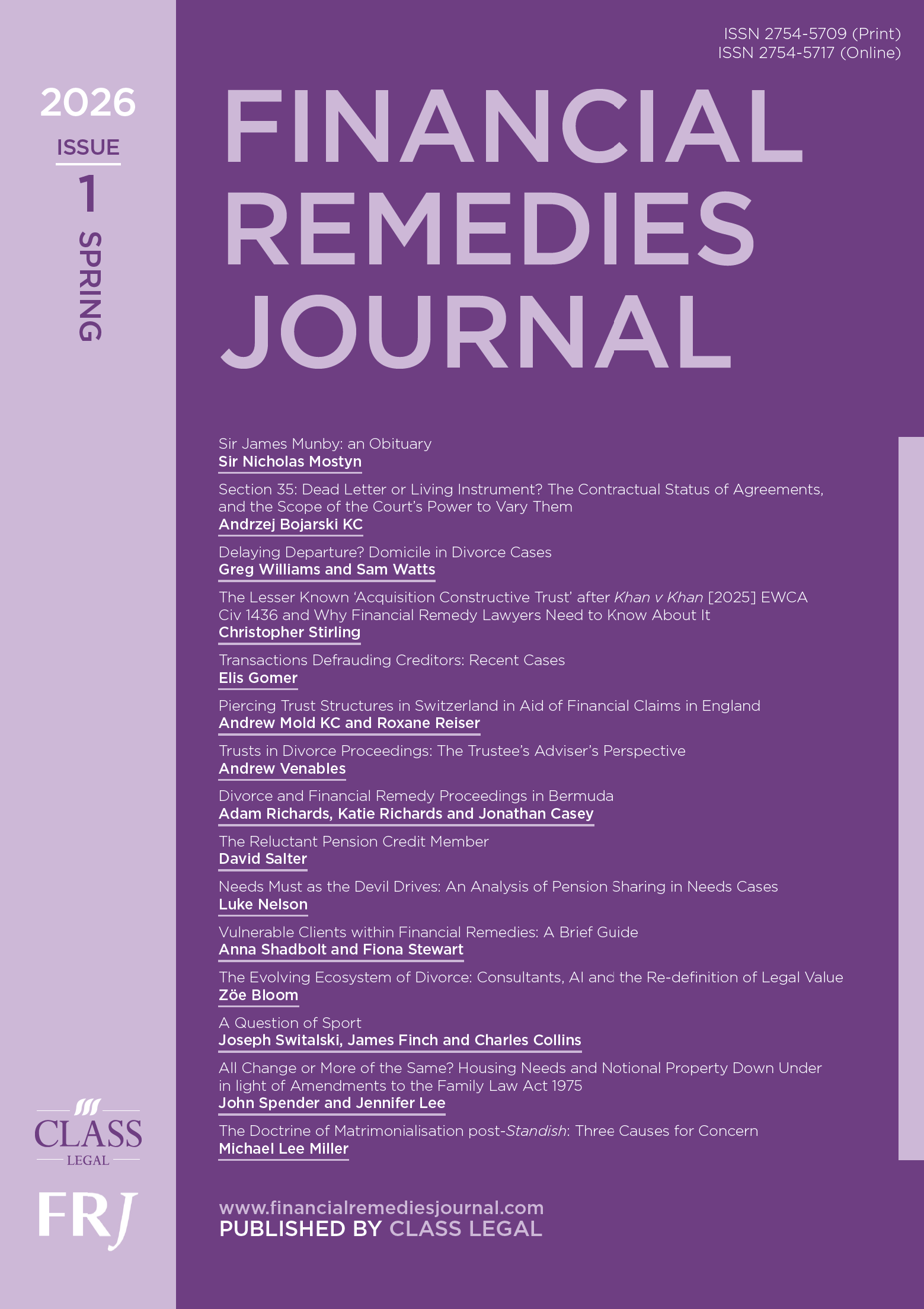
Now out: Financial Remedies Journal 2026 Issue 1 (Spring 2026)

Stop! In the Name of the LSA: Why Your Favourite Legal Exec Can’t Touch That Form A after Mazur and XX v GH