
Trusts in Divorce Proceedings: The Trustee’s Adviser’s Perspective
[2026] 1 FRJ 30. This article provides a perspective on trusts within English financial remedy proceedings, from the perspective of trustees and law firms in Jersey. These days, the view of offshore trusts as a vehicle for hiding assets from authorities, creditors and spouses is unlikely to be true.
There is sometimes an impression that the world of family law sees offshore trusts as a vehicle for hiding assets from revenue authorities, creditors and/or dissatisfied former spouses. These days, in Jersey at least, that is unlikely to be true: if one wants to hide assets there are much better places to do it than in a jurisdiction with mandatory reporting of ultimate beneficial ownership.
This article aims to provide a perspective on trusts within English financial remedy proceedings, from the perspective of trustees and law firms in Jersey.
Preliminary matters
Regulatory context
Offshore trusts go through phases of popularity for different types of asset and client. Most trust companies in Jersey offer a full range of fiduciary services to private, corporate and institutional clients. Trust companies are regulated by the Jersey Financial Services Commission. The Jersey financial services sector takes its regulation seriously, because compliance helps Jersey (and its financial services sector) to avoid criticism by, inter alia, the OECD, FATF and MONEYVAL.[[1]]
That is not to say that one cannot find some trustees who seem to be willing to sail close to the wind. For most trust companies, however, it would be commercially unattractive to do anything that might risk criticism from the regulators.
In addition, proceedings for breach of trust are not uncommon, and there are some cautionary tales from events in the early 2000s arising from trustees being too compliant to a settlor’s wishes. This is in no small part facilitated by the long tail of secondary limitation: in some circumstances, proceedings can be brought 21 years after the breach.[[2]]
Private trust companies
The distinction between a trust company and private trust company (PTC) is important. A PTC is a company created to act as trustee of a trust (or several related trusts), usually set up by an individual or a family. They are often the preferred vehicle if the settlor wants to involve persons other than officers of a trust company in the decision making. That is achieved by having them on the PTC’s board.
PTCs are subject to similar legal and regulatory requirements as trust companies. They must be administered by a regulated trust company, so will generally have local directors who are officers of the administering trust company.
Everything that is said in this article also applies to PTCs. The distinction, however, is that if one must engage with a trust run by a PTC, enquiries must be directed to the PTC rather than the administering trust company (which may be a mailbox at a trust company).
Jurisdiction and firewall provisions
The Jersey Royal Court has jurisdiction over trusts whose proper law is Jersey (regardless of where the trust is run from), and over trusts using another jurisdiction’s law if the trustee is Jersey resident, if the trust has property situated in Jersey, or if the administration of the trust is carried out in Jersey.[[3]]
Like other offshore jurisdictions, Jersey has ‘firewall’ provisions. The current iteration of those laws (brought into effect in October 2006) prevent the decisions of foreign courts (and tribunals) being enforceable or given effect by the court to the extent that they apply foreign (i.e. non-Jersey) law.[[4]]
What happens when those firewall provisions conflict with orders of the English financial remedy courts is considered later.
Applications to court
The role of the Royal Court
The Royal Court exercises a supervisory jurisdiction over Jersey trusts (and relevant foreign trusts). A trustee can apply for directions regarding how they should exercise their powers, or in any matter concerning the trust.[[5]] The court can make orders directing the trustee take any step that is within its power.[[6]] The Jersey court also has the power to make declarations as to the validity of trusts.[[7]] Applications for directions can also be made by a beneficiary,[[8]] and third parties can make applications for directions (but may only do so with permission of the court).[[9]]
Applications for directions fall into four broad categories. First, questions of construction of the trust powers, including determining validity of the trust. Second, applications for the court to approve a decision the trustee has taken. Third, applications where the trustee is unable to decide (often owing to a conflict) and surrenders the decision to the court. Last, situations where the trustee has made the decision, but the decision is under attack by beneficiaries on the basis it is outside their powers (formally invalid) or an improper exercise of the discretion (substantially invalid).[[10]]
Most frequently, the court is being asked to give its approval to a decision which the trustee has already taken (but not implemented). Obtaining the court’s blessing protects the trustee from any breach of trust claim that beneficiaries might later pursue in relation to the decision. The beneficiaries (including any minors) will be joined as parties to the application.
The subject matter of those applications includes major distributions from the trust, decisions to sell trust assets, deciding whether to submit to a foreign jurisdiction, etc.[[11]] There are examples, considered later, arising from the interaction between English financial remedy proceedings.
The courts discourage applications which have the effect of asking the court to exercise discretionary powers vested in the trustee (unless the trustee is unable to exercise the discretion).[[12]] Once a decision has been made, the court will, generally, only intervene where a decision is ‘one which no reasonable trustee could arrive at’.[[13]] Applications for directions are also available in respect of decisions by trust protectors.
Decisions by trustees about whether to provide information to beneficiaries are an exception and are discussed below.[[14]]
Practicalities
The process of trustee decision-making and consequential applications to court are described briefly, to set expectations about timescales when trustees are asked to make non-routine decisions (as might arise when a trustee becomes involved in financial proceedings on divorce).
The first step is for the trustee to make a decision. The trustee will usually need legal advice, and will very likely need to consult the beneficiaries (which might require the beneficiaries to be given time to obtain legal advice). Having taken (and properly minuted) the decision, the trustee then needs to communicate the decision to the beneficiaries. For most decisions, this whole process will likely take at least a month or two.
Only when the decision-making process has concluded would the trustee issue proceedings for court approval or directions. The process is similar to proceedings under Civil Procedure Rules 1998 Part 8. The trustee files evidence and gives full and frank disclosure of the material relating to the decision, along with an explanation of their reasons for the decision. Beneficiaries are joined to proceedings and may be directed to file evidence (with the trustee usually being afforded a right of reply).
Even in a simple and uncontested case, court approval is unlikely to be a quick process. In the simplest situation (i.e. those that are uncontentious and where the sole purpose for obtaining the blessing is for the protection it provides), 4 months would be a best-case scenario. For very complex transactions (often involving multiple decisions, each of which requires a decision on directions and then implementation before the next decision), the whole process might take years. From the trustee perspective, however, the immunity conferred by the blessing is important to have. A well-advised trustee is likely to want court approval of decisions which have the capacity to adversely affect some (or all) of the beneficiaries.
Access to information
A common problem arising is how to obtain information about a trust. There are two approaches. First, by securing disclosure orders in England against the beneficiary spouse to require him/her to obtain information from the trust. Second, by obtaining information from the trust directly. Each issue is approached in turn.
Providing information to beneficiaries
The core rules relating to the provision of information to a beneficiary are codified. The starting point is the trust instrument, which may impose duties on the trustees to provide (or not provide) certain information.[[15]] Subject to the terms of the trust, and to any order of the court, beneficiaries may request disclosure of documents ‘which relate to or form part of the accounts of the trust’.[[16]] A trustee may refuse a request for disclosure if it concludes that it is in the interests of one or more beneficiaries to refuse.[[17]] A trustee is not required to disclose documents recording the trustee’s deliberations or reasons for the exercise of their powers.[[18]] Letters of wishes often state whether the writer wishes the trustees to disclose it to the beneficiary, but there is no right to inspect a letter of wishes (and the courts are generally reluctant to interfere with a trustee’s decision on that issue).[[19]] The trust instruments are also disclosable, unless there is good reason to refuse disclosure.[[20]]
Notwithstanding those rules, the court has a general power to make orders relating to the provision of information to beneficiaries or even third parties.[[21]] The court will ultimately look to balance the interest of the various beneficiaries, the trustees and third parties.[[22]] The court is likely to be reluctant to order disclosure of correspondence between trustees and beneficiaries (other than correspondence involving the requesting beneficiary).[[23]]
Where the costs of disclosure are likely to be significant, the beneficiary requesting disclosure will be required to meet the cost (including, potentially, the trustee’s costs of legal advice).[[24]]
The leading authority on disclosure to beneficiaries was a matrimonial case. It concerned a husband who was ordered to try to obtain various documents (including the letter of wishes) from the trustee so they could be disclosed to the wife.[[25]] In that case (notwithstanding the fact there was a concern that the English assets of the trust might be attacked), the court decided the interests of the beneficiaries as a whole were best served by disclosure. However, in other cases where the validity of the trusts has been under attack by a beneficiary in proceedings in another jurisdiction, the courts have refused to order disclosure to beneficiaries who would use that material as part of their attack on the trust.[[26]]
The approach of the court is, invariably, highly fact-specific. In one case where both spouses were beneficiaries, it was said that ‘the trustee should provide the husband and wife with the fullest financial information concerning the trust … so that any settlement or order made in [the financial remedy] proceedings would be based on the true financial position’.[[27]] In another, the Royal Court cut down the scope of disclosure to limit it to providing a picture of the financial position of the trust.[[28]] And in unusual cases, as above, it may order no disclosure at all.
Companies owned by a trust
A common issue arises where a trust owns companies. It may be difficult to obtain a meaningful picture from the trust accounts, as they not infrequently record shareholdings by reference to the par value of the shares rather than the net asset value of the company. Company accounts are thus important. It is not uncommon for a Jersey trust to hold the shares of a holding company which owns the trust’s assets (sometimes through a further subsidiary).
Strictly speaking, the trustees have the same rights as a shareholder does in respect of the documents belonging to the company. This poses difficulties when a trustee (or, more usually, one of its officers) is also a director.[[29]] The trustee then owes a duty of confidentiality to the company of which it is a director. The Jersey courts have approached disclosure of such documents by looking at how the trustee acquired the document and asking whether disclosure is necessary to enable proper supervision of the trust.[[30]] The starting point, however, is that company law will prevail, i.e. the trustee will be entitled to disclose only documents that came to it in its capacity as shareholder.[[31]] The accounts of the underlying companies have been held to form part of the trust accounts and thus be disclosable.[[32]]
Providing information to non-beneficiaries
This position of non-beneficiaries is more straightforward. They are entitled to seek an order under Art 29(5) Trusts (Jersey) Law 1984 (if they can persuade the court to give them permission to apply). Such an application ultimately falls to be determined on application of the same principles as described above, i.e. a balancing of the interests of the applicant third party and the interests of the beneficiaries. Such applications are likely to be challenging, given the non-beneficiary has no direct interest in the information. Given that it would almost always be easier to obtain an order in England that the beneficiary-spouse seek disclosure from the trust, that approach is the one invariably preferred.
That does not close the door to non-beneficiary spouses obtaining information from the Jersey trust in a case where the beneficiary spouse will not cooperate. The non-beneficiary spouse may use letters of request.[[33]] The court may make various orders, including providing for examination of witnesses (either orally or in writing) and the production of documents.[[34]] However, there are some limits, most importantly that a person cannot be compelled to give evidence which they could not be compelled to give in civil proceedings in Jersey.[[35]]
Unsurprisingly, this has led to cases where non-beneficiary spouses have used letters of request to try to obtain information about trust assets. As a general principle, the Jersey courts will always try to give effect to letters of request,[[36]] and in order to do so may delete elements of the request or limit it to those parts which are not impermissible under Jersey law.[[37]]
The Jersey courts will generally accept the decision of the requesting court as to whether information has been requested appropriately and is for a proper purpose.[[38]] However, as trust information is confidential, the courts will balance the interest in preserving that confidentiality against the other interests (in particular, the ability of a court to get ‘as nearly as possible to the truth’ and judicial comity).[[39]] The court may consider, by analogy, whether information would be directed to be disclosed if the matrimonial proceedings were taking place in Jersey: if so, the letter of request is likely to succeed.[[40]] However, the court will not permit letters of request to undermine the confidentiality of proceedings brought by a trustee for directions (in which the trustee is under an obligation of full and frank disclosure).[[41]]
Implementing English orders in Jersey
Two types of situations might arise. The first is an order under s 24(1)(c) Matrimonial Causes Act 1973 to vary a nuptial settlement. The second is where an order might be made (usually for a lump sum) that the payer is only able to implement if they receive money from a trust.
Before turning to those scenarios, two warnings are called for. The first is that a Jersey trustee, of a Jersey law trust, is under no duty to comply with an order made in England (particularly if it conflicts with their legal obligations under Jersey law).[[42]] The second is that attempts by English matrimonial courts to hold that trusts are a sham, or otherwise not valid, are unlikely to be well received, particularly if the decision applies English law.[[43]]
Implementation of variations of trusts
It is important to note, if looking at Jersey case law, that the legislation changed in late 2006 to provide that the firewall provisions apply to override of general rules of private international law (including those regarding submission to the jurisdiction).[[44]] Cases under the previous legal framework concern legislation which was more permissive of enforcing overseas orders against trusts under general principles of private international law.[[45]]
There is a core principle running through the modern case law (particularly the leading case, Mubarak v Mubarak [2008] JRC 136). The firewall provisions prevent the enforcement or giving effect of decisions of foreign courts where they are based on foreign law (which a decision under the MCA 1973 is). However, that is legally different from a trustee deciding (after applying its own decision-making process) to exercise its powers in such a way as to implement a decision of a foreign court (or even the court directing, on application of the interested party, the trustee to do so).[[46]] The trustee may decide to adopt the reasoning of the foreign court, provided it considers all relevant matters.
The key factor in the latter scenario is that the trustee must have the power to do the thing it is being asked to do (whether to appoint a new beneficiary, appoint monies to a sub-trust, distribute money out, etc).[[47]] If the trustee does not have the power, the Royal Court has no power to alter a trust by doing something the trustee cannot.[[48]] Further, as an order under MCA 1973, s 24(1)(c) altering the terms of a Jersey trust is an order made under English law, it is incompatible with the firewall provisions. It cannot be implemented (even if the trustee submits to the jurisdiction in England).[[49]]
However, if the trustee has the power to take the action required, the trustee can lawfully decide (after considering all the relevant circumstances) that it is in the interests of all to resolve the financial dispute between the spouses, and thus exercise its powers to implement the order. Invariably, whether this is possible will turn on a careful evaluation of the trust instrument, and specialist advice will be essential.
An alternative option is the approach that ultimately succeeded in Mubarak, although its utility depends on several factors. In Mubarak, the English court had directed the beneficiary spouse to write to the trustee (in irrevocable terms) to say that he wished for the trustee to implement the orders of the English court. This was a condition of not being debarred from participating, under a Hadkinson order.[[50]] (As a side note, this approach does not work if the letter is compelled out of the beneficiary by threat of being held in contempt if he/she does not sign.[[51]]) If the other adult beneficiaries give the same consent to alter the trust in that way, the court can give consent for the minors and unborn, thereby permitting alteration of the terms of the trust.[[52]] This is, however, of no use if there are other adult beneficiaries who will not cooperate.
Joining the trustee
In any case where a variation of nuptial settlement is sought, the trustee will likely be joined in England. However, an order of joinder does not necessarily mean the trustee will participate. Indeed, generally it is unlikely to be in the interests of the beneficiaries for the trustee to submit to the jurisdiction of the English court.[[53]] One exception is if a trust is likely to be viewed as nuptial and there are assets in the UK which the Family Court might appropriate. In that scenario, the trustee might think it better (depending on the value of the trust assets) for the beneficiaries that the trustee be heard in the family proceedings.
Even in that scenario, the trustee is likely to seek directions from the court to approve their decision, particularly if the decision is to submit. Whilst waiting for the court to make that decision, the trustee will not want to implement it by participating. In that situation, a decision to carry on in England without the trustee, on the assumption that the reason the trustee has not engaged is because it is being obstructive, is likely to be counterproductive.
Implementation of lump sum orders
This is the only possible approach if either: (1) a trust is not a nuptial settlement; or (2) it is a nuptial settlement but the trustee’s powers do not permit variation required to achieve the desired outcome for the claiming spouse.
A lump sum order has no effect on the trust, but it puts the receiving party in the position of judgment creditor.[[54]] It is permissible under Jersey law for a trustee to advance money to a beneficiary to pay off creditors, if satisfied that this is for the benefit of the beneficiary.[[55]]
Whether this type of ‘judicious encouragement’ to the trustee works is a different question. From the trustee’s perspective, much will depend on the nature and value of the assets in the trust, the wishes of the economic settlor, and the circumstances of other beneficiaries. Before making a distribution for this purpose, the trustee will likely seek the blessing of the court.
Other issues relating to implementation
Exclusion after implementation
It is unlikely that both spouses can continue as beneficiaries of the same trust after the divorce. Exclusion may come about automatically on the final divorce order if one spouse’s interest arises by virtue of that status. Where both spouses are named, the trustee will likely wish to use any power of exclusion that arises in the trust.
As a starting point, in any case where a clean break has been imposed after transfer of money or assets to one spouse, it is likely that the trustee will thereafter think it appropriate to exclude that spouse as a beneficiary. Provided the exclusion takes effect only after the monies have been paid or assets transferred, the court is likely to endorse this.[[56]]
Implementation of s 37 set aside orders
This is somewhat of a nascent topic in Jersey. There is a customary cause of action (‘the Pauline action’) that is similar to s 423 Insolvency Act 1986. The Pauline action is only available where there is a creditor with a claim that pre-dates the disposition, the debtor was insolvent at the time of the disposition (or became insolvent as a result), if the disposition was made with an intention on the part of the debtor to prejudice his creditors, and actual prejudice is caused. The Pauline action is unlikely to assist in the family context, save where an order under s 37(2) MCA 1973 is made to avoid a disposition intended to defeat enforcement of financial remedy orders that have been made.
The policy behind the Pauline action is plain: Jersey does not wish to provide the means by which debtors can defraud their creditors.
In some situations, it is possible to combine that principle and a s 37(2) set aside order with the trustee’s powers. In that situation, it is possible to use the trustee’s powers to unwind the transaction and return the assets to the spouse that transferred them into the trust.[[57]]
Freezing injunctions
It is sufficient briefly to note that the mirroring of freezing orders made in other jurisdictions is a common occurrence in Jersey. Of course, one cannot convert a freezing order against a spouse into a freezing order against a trustee. However, obtaining a mirror injunction against the spouse and citing the trustee as an interested party in order to bind them to the anti-assistance provisions in the freezing order may be a better solution than seeking an injunction against the trustee (although the latter is possible).
Conclusion
By asking appropriate questions of the spouse who is a beneficiary (including requests for information from his/her knowledge, such as to ask what distribution he/she has previously received, and also requiring him/her to make focused requests of the trustee), it is quite possible to obtain useful information as to the scope and nature of the resources available, and likelihood of some of those resources being made available. Similarly, with good planning and a realistic final order, it is quite possible to obtain implementation by distributions from the trust. Conversely, asking the trustee to take steps that would put them in breach of trust is likely to reduce the likelihood of that happening. A strategy informed by Jersey law is most likely to produce a successful result.
Author’s note: with thanks to Guillaume Staal (of Dickinson Gleeson) for his comments and suggestions.
[[1]]: The Organisation for Economic Co-operation and Development, the Financial Action Taskforce, and the Council of Europe’s Committee of Experts on the Evaluation of Anti-Money Laundering Measures and the Financing of Terrorism, respectively.
[[2]]: Trusts (Jersey) Law 1984 (Trusts Law), Art 57.
[[3]]: Trusts Law, Art 5.
[[4]]: Trusts Law, Art 9(4).
[[5]]: Trusts Law, Art 51.
[[6]]: Trusts Law, Art 51(2). A decision to write off a loan to a beneficiary may also generate a blessing application if the loan is large enough. It is common for tax reasons for payments to be framed as loans.
[[7]]: Trusts Law, Art 51(2)(b).
[[8]]: Trusts Law, Art 51(3).
[[9]]: Trusts Law, Art 51(3).
[[10]]: Re S Settlement [2001] JRC 154.
[[11]]: Re H Trust; X Trust Company v RW & Ors [2006] JLR 280.
[[12]]: S v Bedell Cristin Trustees Ltd [2005] JRC 109. There is an exception where the trustee surrenders its discretion to the court, although such cases are relatively unusual and are beyond the scope of this article.
[[13]]: S v Bedell Cristin Trustees Ltd (above).
[[14]]: Re Y Trust, E Trust Company Ltd v B, C & D [2014] 1 JLR 199.
[[15]]: Trusts Law, Art 29(1).
[[16]]: Trusts Law, Art 29(2).
[[17]]: Trusts Law, Art 29(3).
[[18]]: Trusts Law, Art 29(4).
[[19]]: Re Rabaiotti [2000] JLR 173.
[[20]]: Re Rabaiotti (above).
[[21]]: Trusts Law, Art 29(5).
[[22]]: i.e. applying the principles set out in Schmidt v Rosewood [2003] UKPC 256.
[[23]]: Re Avalon Trust [2006] JRC 105A.
[[24]]: RBC Trust Company (Jersey) Ltd v E; Re B, C, D Settlements [2010] JCA 231.
[[25]]: Re Rabaiotti Settlement (above).
[[26]]: Re L Trusts [2007] JRC 002A.
[[27]]: Re the H Trust; X Trust Company v RW & Ors (above).
[[28]]: Re Avalon Trust (above).
[[29]]: Although it is not invariably the case the trustee will have a presence on the board, in order to benefit from so-called anti-Bartlett clauses.
[[30]]: Re the L Trust [2917] JRC 168A.
[[31]]: Re the L Trust (above).
[[32]]: Re Lombardo Settlement [2000] Jersey Unreported Series 110 (5 December 1990).
[[33]]: Service of Process and Taking of Evidence (Jersey) Law 1960 (Taking of Evidence Law). The 1970 Hague Convention on the Taking of Evidence Abroad in Civil or Commercial Matters has no effect as between the UK and Jersey. The UK has (with the consent of Jersey) brought the 1970 Hague Convention into force for Jersey so it can be invoked by other countries. The Jersey legislation applies to Letters of Request both under the 1970 Hague Convention and otherwise.
[[34]]: Taking of Evidence Law, Art 4. The UK entered a reservation to the 1970 Hague Convention so as to exclude pre-trial disclosure of documents from the scope of the Convention.
[[35]]: Taking of Evidence Law, Art 5(1).
[[36]]: Wadman v Dick [1993] JLR 52.
[[37]]: See Rio Tinto Zinc Corp v Westinghouse Electric Corp [1978] AC 547.
[[38]]: J v Tully & Ors [2016] JRC 110.
[[39]]: Wadman v Dick (above).
[[40]]: J v Tully & Ors (above).
[[41]]: Deary v Continental Trust Company [2010] JRC 001.
[[42]]: FM v ASL Trust Company Ltd [2006] JRC 020A. English solicitors who claimed that the trustee was under such a duty were criticised for it.
[[43]]: Re Fountain Trust [2005] JLR 359, a conclusion endorsed in Charman v Charman (No 2) [2007] EWCA Civ 503.
[[44]]: Prior to October 2006, an order made in England where the trustees had submitted to the jurisdiction was, under Jersey law, enforceable.
[[45]]: In particular Lane v Lane [1985] JLR 48, Compass Trustees v McBarnett [2002] JLR 321 and Re A Trust [2006] JRC 020A no longer accurately state the law.
[[46]]: Re B [2006] JLR 592.
[[47]]: Mubarak v Mubarak [2008] JRC 136.
[[48]]: Mubarak (above).
[[49]]: Mubarak (above).
[[50]]: As was done in Mubarak.
[[51]]: Turino Consolidated Retirement Trust [2007] JRC 100.
[[52]]: Trusts Law, Art 47.
[[53]]: See, e.g. Re H Trust; X Trust Company v RW & Ors (above).
[[54]]: A discussion of the mechanisms for enforcing money judgments in Jersey is beyond the scope of this article: but it should be noted that they are available.
[[55]]: Re Esteem Settlement [2001] JLR 540.
[[56]]: Representation of Otto Poon Trust [2014] JRC 254A.
[[57]]: Re R Trust [2015] JRC 267A.
Related
Chair’s Column (Spring 2026)

Sir James Munby: an Obituary
Section 35: Dead Letter or Living Instrument? The Contractual Status of Agreements, and the Scope of the Court’s Power to Vary Them


Related
Chair’s Column (Spring 2026)
Sir James Munby: an Obituary
Section 35: Dead Letter or Living Instrument? The Contractual Status of Agreements, and the Scope of the Court’s Power to Vary Them
Latest
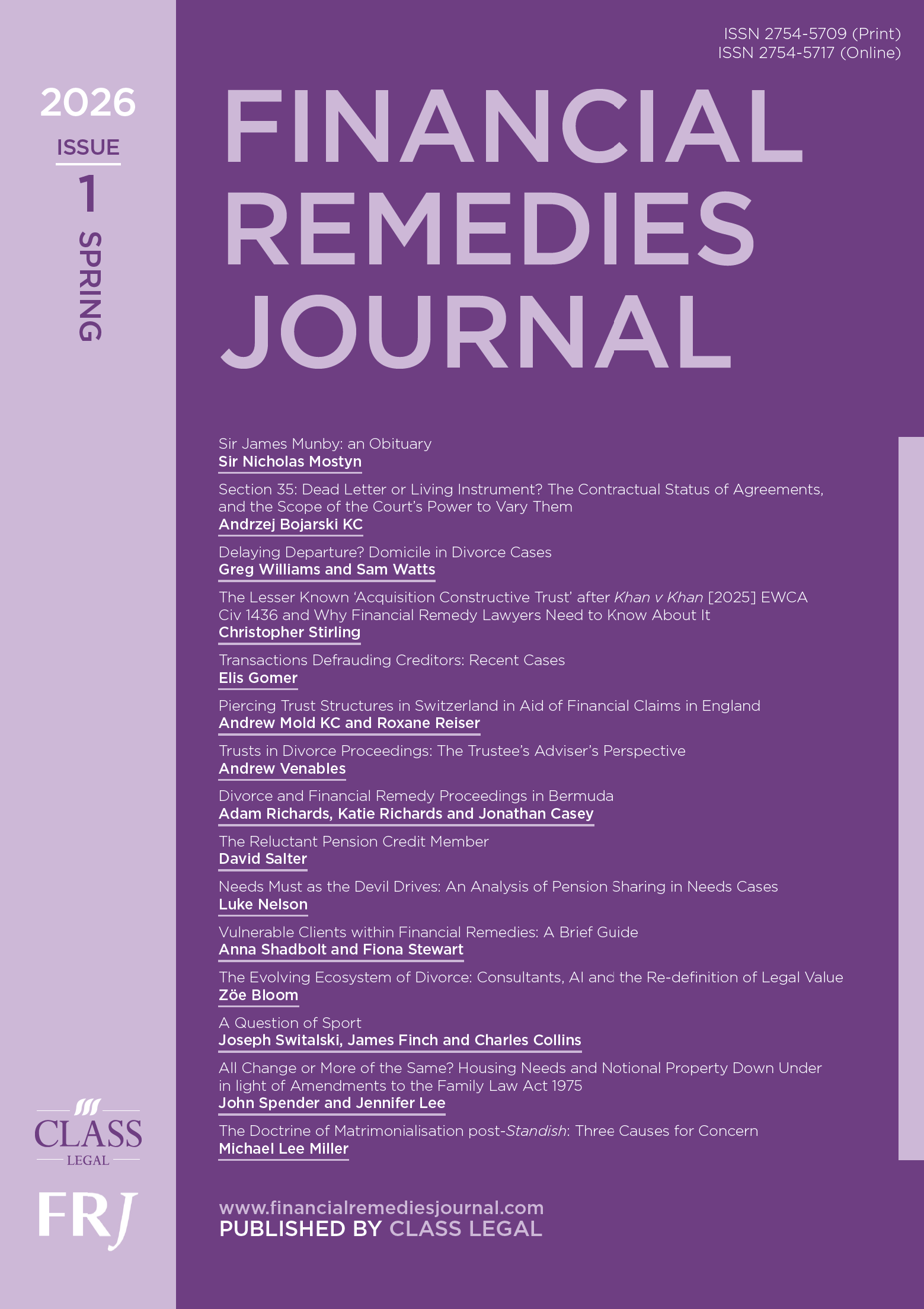
Now out: Financial Remedies Journal 2026 Issue 1 (Spring 2026)

Stop! In the Name of the LSA: Why Your Favourite Legal Exec Can’t Touch That Form A after Mazur and XX v GH