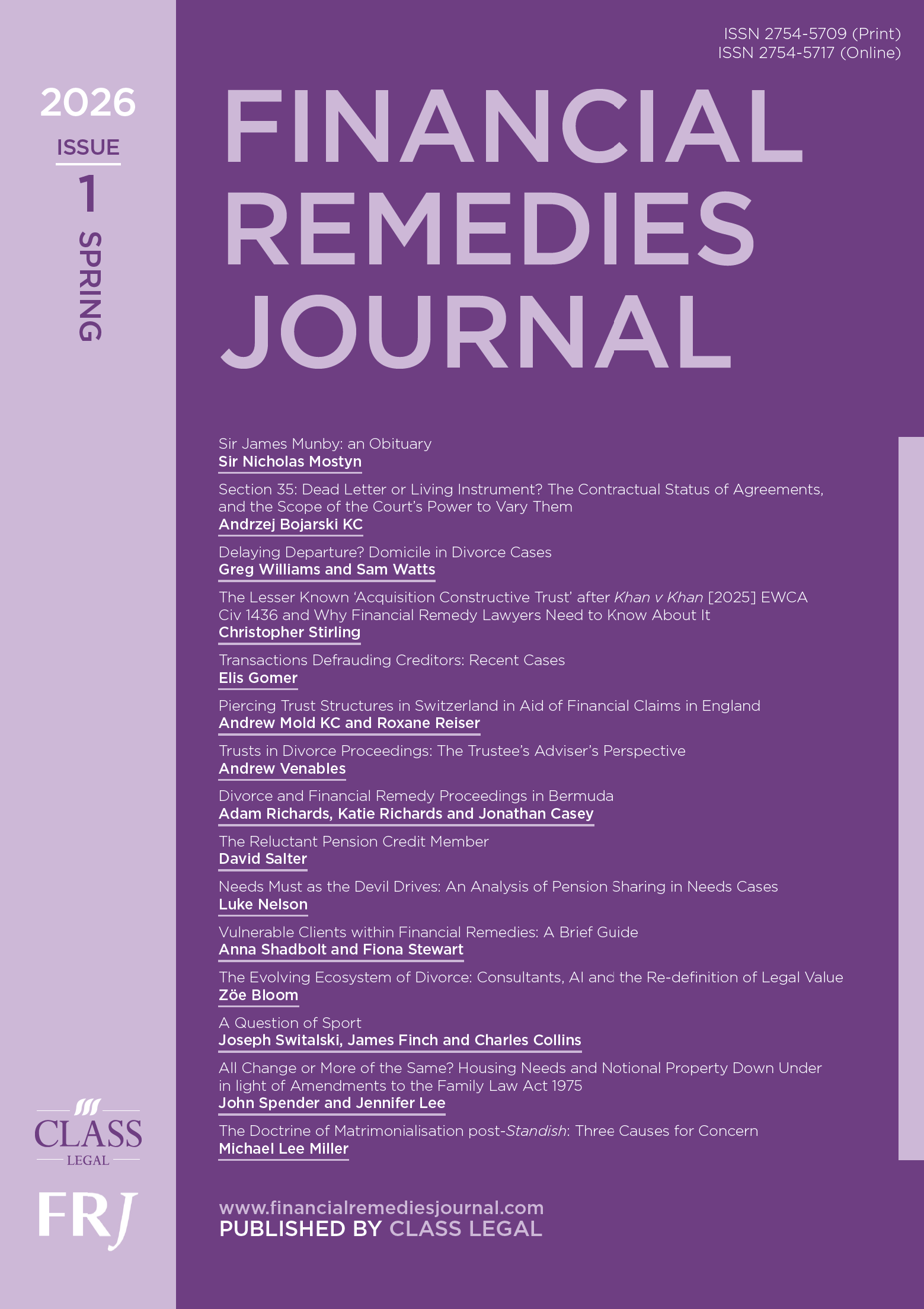
Book Review: Dictionary of International Family Law
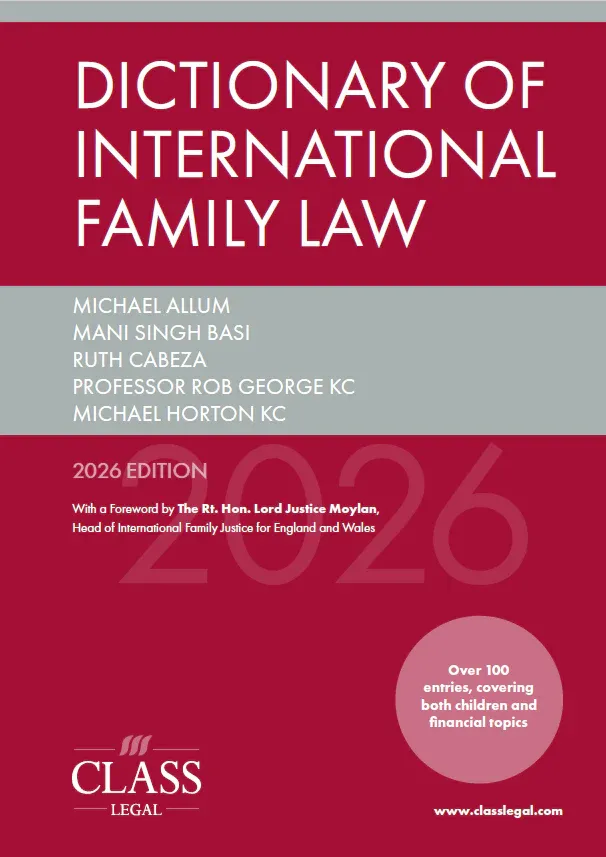
The Dictionary of International Family Law is the latest addition to the series of Class Legal Dictionaries. It joins this distinguished family with confidence and purpose.
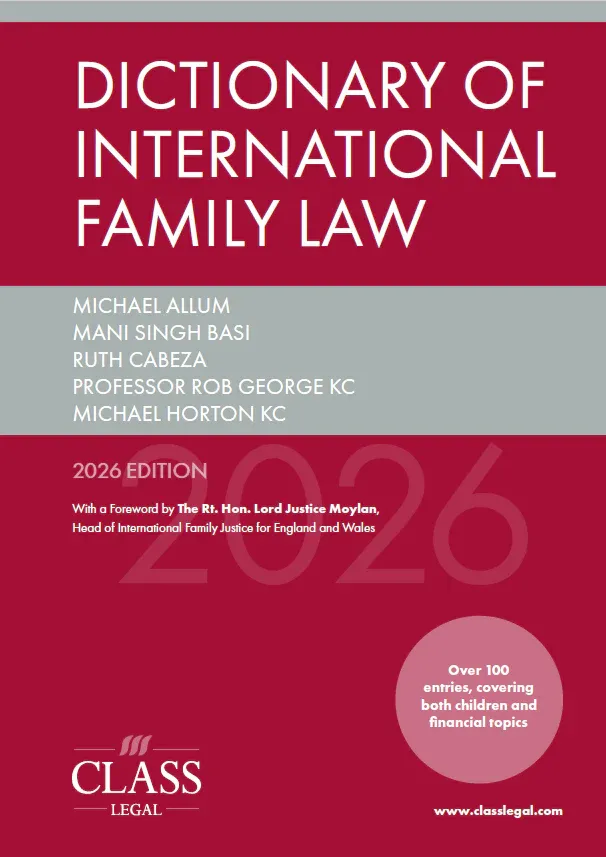
The Dictionary of International Family Law is the latest and much anticipated sixth addition to the renowned series of Class Legal Dictionaries, following in the tradition which begun with the very first Dictionary of Financial Remedies, published in September 2013, a work which quickly became indispensable for practitioners and judges. The Dictionary of International Family Law joins this distinguished family with confidence and purpose. It is meticulously structured, practitioner focused, and committed to distilling complex legal concepts in the international family law arena into a clear and usable format.
This new volume includes a thoughtful and compelling foreword by The Right Honourable Lord Justice Moylan, Head of International Family Justice and the Hague Network Judge for England and Wales. His Lordship rightly recognises that international family law has now emerged as a discrete and distinct category — one sufficiently specialised, complex, and rapidly evolving to justify a dedicated dictionary.
As with the earlier dictionaries, this volume adopts the familiar and accessible A–Z alphabetical arrangement, offering an authoritative distillation of law and practice across the international family law landscape. The structure is intuitive, and its clarity – one of the hallmarks of the Class Legal style – ensures that the dictionary will be instantly usable by those needing rapid, reliable guidance. It is a format particularly well-suited to this field, where issues of jurisdiction, recognition, cross border enforcement, and international child protection often require practitioners to have the necessary information at their fingertips.
The dictionary draws its strength from the exceptional calibre of its well-known authors: Michael Allum, Mani Singh Basi, Ruth Cabeza, Professor Rob George KC, and Michael Horton KC. Collectively, they bring deep expertise spanning both children and financial remedies work, academic analysis, and frontline litigation experience. This breadth allows the dictionary to cover an impressive and wide ranging selection of topics, reflecting the reality that international family law, and disputes involving globally mobile families, rarely fit neatly into one category. Instead, it often cuts across several aspects of family justice – jurisdictional disputes, recognition of foreign marriages and divorces, financial provision after a foreign divorce, assets located overseas, international relocation, sometimes abduction, parentage, and very often, cross-border enforcement.
The authors’ combined experience ensures that each topic is addressed succinctly, but with sufficient depth and practical insight for the busy practitioner. Each entry is concise yet substantive, with reference to key case law, statutory provisions, and international instruments. In my view, the balance achieved – between accessibility and analytical rigour – is one of the dictionary’s greatest strengths.
Some of the excellent entries most relevant to financial remedy practitioners, and which I particularly enjoyed reading, are those on jurisdiction in divorce and financial remedies, recognition of foreign marriages and divorces (including the treatment of polygamous relationships), and the treatment of Part III claims (financial provision after an overseas divorce, with a succinct analysis of the Potanina line of cases and subsequent developments). The entry on pensions in an international context, impressively condensed into a single page, offers clarity in an area which is often dense and technically challenging. The entries on locating assets in international finance cases and on the taking/securing of evidence across borders are also practical and instructive.
For children law practitioners, the dictionary is equally rich. The coverage of child abduction is notably extensive, with an impressive 17 entries dedicated to various aspects of the topic, reflecting its complexity and its importance in international practice. The entries on adoption, spread across nine carefully crafted sections, offer clarity on domestic and international procedures. Equally valuable are the entries on jurisdiction, surrogacy, parentage and parental responsibility, and mediation in international children cases.
I was also particularly impressed by the authors’ coverage of the recognition and enforcement of overseas financial and children orders — an area fraught with risk, and too often overlooked at one’s peril. The dictionary provides crisp, effective guidance on recognition and enforcement, demystifying the interaction between domestic and international frameworks.
The Dictionary of International Family Law represents a significant scholarly and practical achievement. The authors are to be warmly congratulated for producing a volume that matches the high standards set by the Class Legal series. Like its older siblings, this new dictionary deserves, and will undoubtedly secure, rapid and wide acceptance. It is certain to become an essential part of the toolkit of every family law practitioner and judge engaging with international family law issues. Indeed, I can see its appeal extending beyond England and Wales. In fact, I am aware that my international colleagues practising in other jurisdictions (e.g. Singapore, Hong Kong, Australia etc) have already ordered their copies!
Related

Book Review: Financial Remedies Handbook 2025
Book Review: Staying Sane in Family Law
Book Review: Cohabitation Law and Practice Handbook (3rd Edition)


Related
Book Review: Financial Remedies Handbook 2025
Book Review: Staying Sane in Family Law
Book Review: Cohabitation Law and Practice Handbook (3rd Edition)
Latest
Book Review: Dictionary of International Family Law

Beyond Thing 1 and Thing 2: Cryptoassets and the New Property Landscape