
Kay v Martineau Johnson (a Firm) [2026] EWCA Civ 224
Newey, Males, and Lewis LJJ. The Court of Appeal held that a professional negligence claim arising from advice given in financial remedy proceedings was statute barred under s 14A Limitation Act 1980.
Judgment date: 5 March 2026
https://caselaw.nationalarchives.gov.uk/ewca/civ/2026/224
Newey, Males, and Lewis LJJ. The Court of Appeal held that a professional negligence claim arising from advice given in financial remedy proceedings was statute barred under s 14A Limitation Act 1980.
Background
In 2007 Ms Ellen Kay instructed the defendant firm, Martineau Johnson, to advise her in financial remedy proceedings arising from her divorce; [3].
Prior to settlement Ms Kay suspected that her husband had not fully disclosed his assets; [5]–[6]. At the financial dispute resolution hearing on 25 April 2008 she nevertheless agreed to a clean break settlement. The agreement was later recorded in a consent order dated 29 September 2008; [4].
Following the settlement Ms Kay raised concerns about disclosure and asked the firm whether the agreement could be reopened. The firm advised that there were no grounds to challenge the order; [7]. Ms Kay terminated the firm’s retainer in June 2009.
On 23 April 2018 Ms Kay requested her file from the firm. Counsel was instructed on 27 March 2020 to advise whether the settlement could be challenged. Counsel advised on 3 May 2020 that an application to set aside the order would not succeed because there was insufficient evidence of non-disclosure.
Ms Kay issued professional negligence proceedings against the firm on 6 March 2023.
Limitation framework
Section 14A of the Limitation Act 1980 provides a special limitation regime where the claimant did not know the relevant facts when the cause of action accrued.
Section 14A(5) provides that proceedings must be brought within three years from:
‘the earliest date on which the plaintiff … first had both the knowledge required for bringing an action for damages in respect of the relevant damage and a right to bring such an action.’
Section 14A(10) provides that knowledge includes knowledge which a claimant:
‘might reasonably have been expected to acquire … from facts observable … or from facts ascertainable … with the help of appropriate expert advice which it is reasonable for him to seek.’
As explained in Haward v Fawcetts [2006] UKHL 9, there is a distinction between actual and constructive knowledge.
- Actual knowledge is knowing enough of the material facts to make it reasonable to investigate whether there is a potential claim.
- Constructive knowledge is knowing enough to make it reasonable to acquire, with or without help, further knowledge sufficient to become actual knowledge.
The appeal arguments
Ms Kay argued that she did not have actual knowledge of a negligence claim in 2009 because she continued to regard the firm’s advice as sound. She also argued that she had taken reasonable steps by returning to the firm for advice and that any delay in seeking independent advice was due to impecuniosity; [31]–[32].
The firm argued that the trial judge’s findings should not be disturbed. While it had been reasonable initially to seek advice from the firm, once Ms Kay was told that the settlement could not be reopened she ought reasonably to have sought independent advice. The firm also argued that impecuniosity was irrelevant to s 14A(10) and not established on the evidence; [33]–[34].
Judgment
The Court of Appeal held that Ms Kay did not have actual knowledge of negligence in 2009. Although she knew that she regarded the settlement as unsatisfactory, she did not know that the alleged damage was attributable to negligent advice given by the firm; [78]–[82].
However, Ms Kay had constructive knowledge within the meaning of s 14A(10) by June 2009. By that stage she knew enough to investigate whether her position might have resulted from faulty advice given by the firm. As the statutory test is objective, the fact that it had not occurred to Ms Kay to investigate that possibility did not prevent constructive knowledge arising; [83]–[90].
The court rejected Ms Kay’s argument that the relevant facts could not be identified until she obtained her file in 2018. The issue was whether she had taken reasonable steps to obtain expert advice capable of identifying the relevant facts. The court held that the relevant information could have been identified earlier with appropriate advice; [60]–[63].
Ms Kay’s reliance on impecuniosity was also rejected. The court held that it was doubtful whether impecuniosity could affect the operation of s 14A(10) and that the evidence did not establish that lack of funds prevented Ms Kay from obtaining earlier advice; [64], [69].
Held
Newey LJ delivered the leading judgment. Ms Kay had constructive knowledge of the relevant facts by June 2009 for the purposes of s 14A of the Limitation Act 1980. The three-year limitation period therefore expired long before proceedings were issued in March 2023 and the claim was statute barred. The appeal was dismissed; [75].
Males LJ agreed but emphasised the importance of maintaining the distinction between actual knowledge and constructive knowledge under s 14A; [77]. Lewis LJ agreed with both judgments.


Latest

Beyond Thing 1 and Thing 2: Cryptoassets and the New Property Landscape
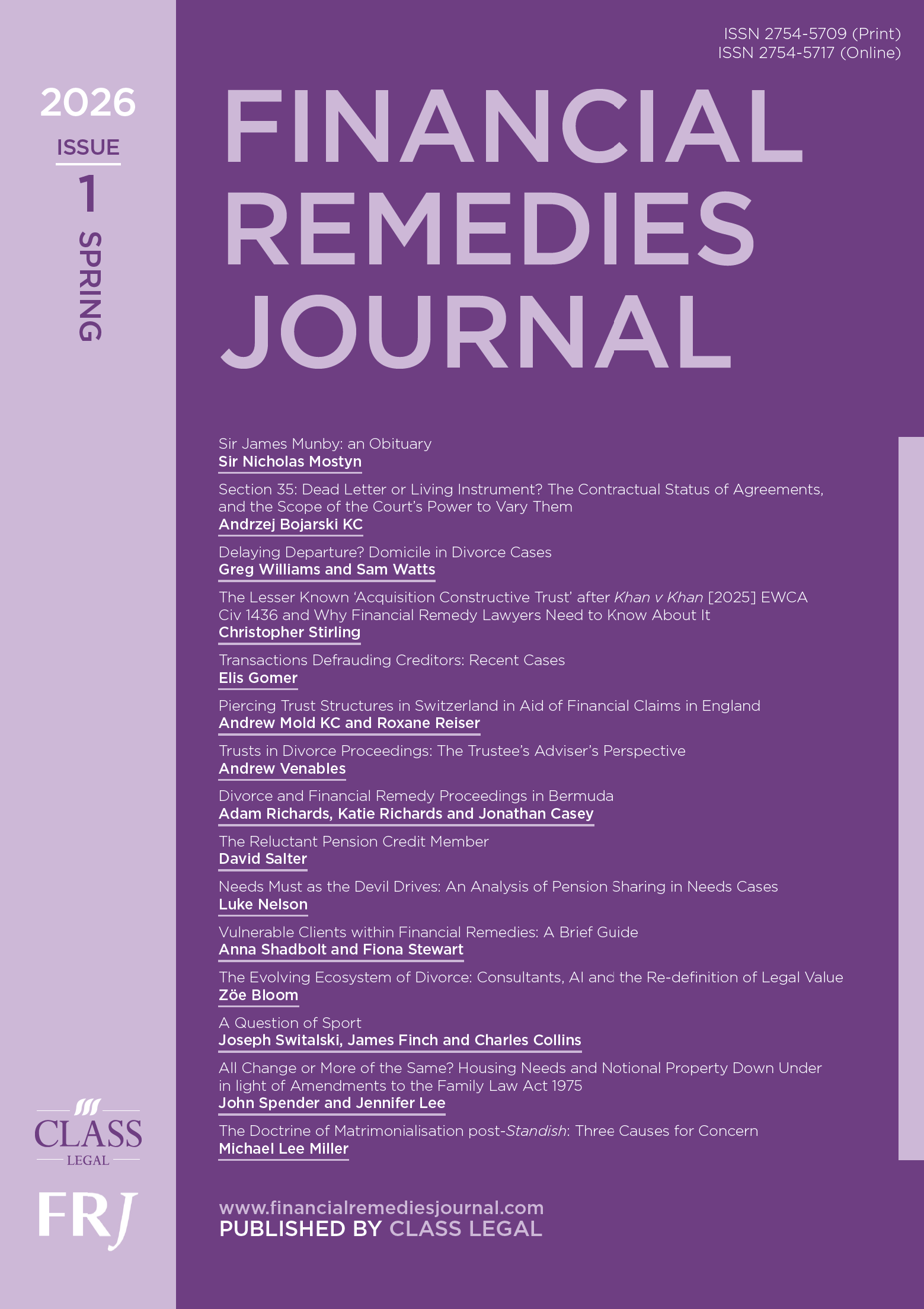
Now out: Financial Remedies Journal 2026 Issue 1 (Spring 2026)