
FG v BN (Appeal Out of Time) [2026] EWFC 101 (B)
8 May 2026. Recorder Chandler KC. In this important judgment, H failed to obtain relief from sanctions for filing his appeal 10 months late. A good explanation for the first 6 months’ delay did not excuse unexplained inactivity in the final 4 months.
Judgment date: 8 May 2026
https://caselaw.nationalarchives.gov.uk/ewfc/b/2026/101
Recorder Chandler KC. In this important judgment, H failed to obtain relief from sanctions for filing his appeal 10 months late. A good explanation for the first 6 months’ delay did not excuse unexplained inactivity in the final 4 months.
Background
The parties were 74 (H) and 58 (W) respectively, and had been married for 26 years. They had one child, aged 21, who was at university.
In FR proceedings, H had failed to file his Form E or first appointment directions, had failed to respond adequately to his solicitors, and had failed to attend the final hearing in January 2025. He was not represented at the final hearing either.
The final hearing had gone ahead without him. The court inferred that H had substantial undisclosed assets and pension rights. A clean break order was made. H retained his pension (£700k) and W received £900k (£700k for housing needs; £200k for income needs). The overall effect was while the wife’s needs were met, there was an overall more or less equal division of capital with H retaining his more valuable pensions.
The husband appealed 10½ months later, arguing that the asset calculations and the amount inferred to him were wrong, and that the DJ failed to properly distinguish matrimonial from non-matrimonial property.
The ‘out-of-time’ issue
The appeal was treated as an application for relief from sanctions under FPR 4.6. The court applied the three-stage approach in Denton v TH White Ltd [2014] EWCA Civ 906, which TRC v NS [2024] EWCA 80 (Fam) says applies to family cases:
- seriousness and significance of failure to comply;
- why the default occurred;
- all the circumstances of the case including the checklist in FPR 4.6(1) as to what the court must consider.
As to:
- all the circumstances of the case.
The judge had miscalculated some aspects of the assets including the value of H’s pension; and the scope of the adverse inferences was too broad. These grounds of appeal had merit but the judge did not resolve the question of whether this amounted to having a ‘real prospect of success’.
As to:
- the interests of the administration of justice.
The principle of finality of litigation versus the merits of the appeal. The merits of the appeal only carry significant weight at the extension-of-time stage only where they are obviously very strong or very weak: this was not the case here. The judge distinguished from Hussain v Hussain [2021] EWFC 13’s impossible lump sum calculation; and Re D (A Child: Appeal Out of Time) [2020] EWHC 1167 (Fam)’s serious procedural irregularities and unsafe findings of sexual abuse.
As to:
- whether the failure to comply was intentional;
- whether there was a good reason for the failure.
On these issues the court held that the delay was significant; the husband gave various reasons including mental ill health, and legal advice issues. Evidence must address the original inability to engage, the subsequent recovery, the assistance obtained and the steps taken to progress the proceedings.
When relying on legal advice as an explanation for delay, the court requires the precise advice, when it was received and what action followed. The court will need to examine the relevance correspondence and file.
Mental ill health does not automatically establish a good explanation and the functional consequences of the diagnosis must correlate to the entire period of non-compliance. In the H’s case it did not correlate.
The judge held that the period of delay of six months was on the combined issues accepted; but the last four months’ delay was unacceptable.
As to:
- the extent to which the party has complied with other rules.
In this case, the husband comprehensively failed to comply with court directions prior to the final hearing, including all of the First Appointment directions which included a penal notice.
As to:
- the effect the failure to comply has had on each party; and
- the effect the granting of relief would have on each party.
The wife has been left in limbo for some 15 months.
Weighing all of these factors into account, H should not be granted relief from sanctions. The husband’s appeal was therefore dismissed.
H sought permission to introduce new evidence
- The relevant test was Ladd v Marshall [1954] EWCA Civ 1.
- The judge, given the outcome of the relief from sanctions application, did not need to consider this, but noted that H had used a witness statement to introduce new evidence through the back door (i.e. bypassing the Ladd v Marshall test) and this was not acceptable. A separate application and permission are required where a party wishes to rely on a witness statement supporting an appeal.


Latest
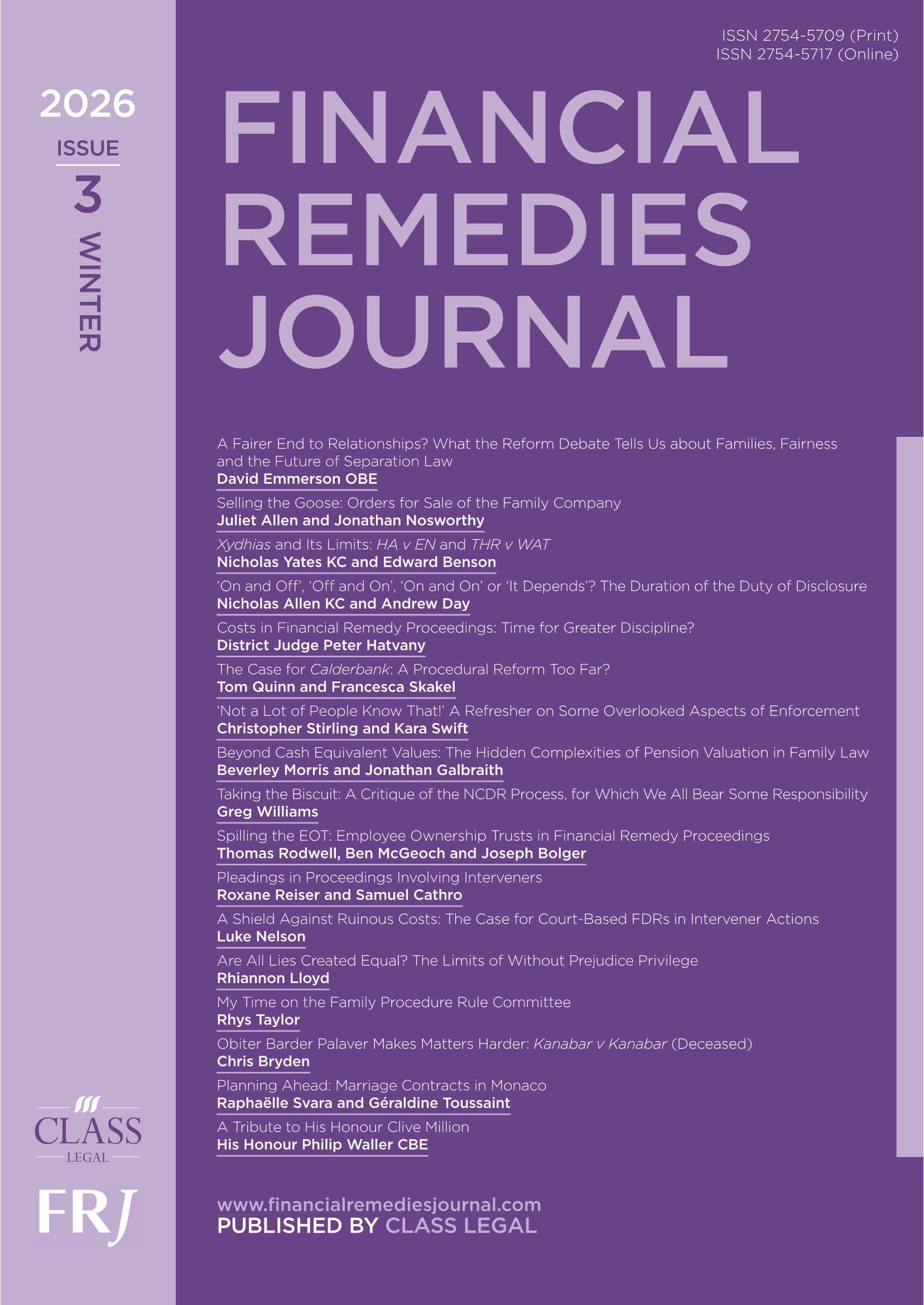
Now out: Financial Remedies Journal 2026 Issue 3 (Winter 2026)
The Case for Calderbank: A Procedural Reform Too Far?