
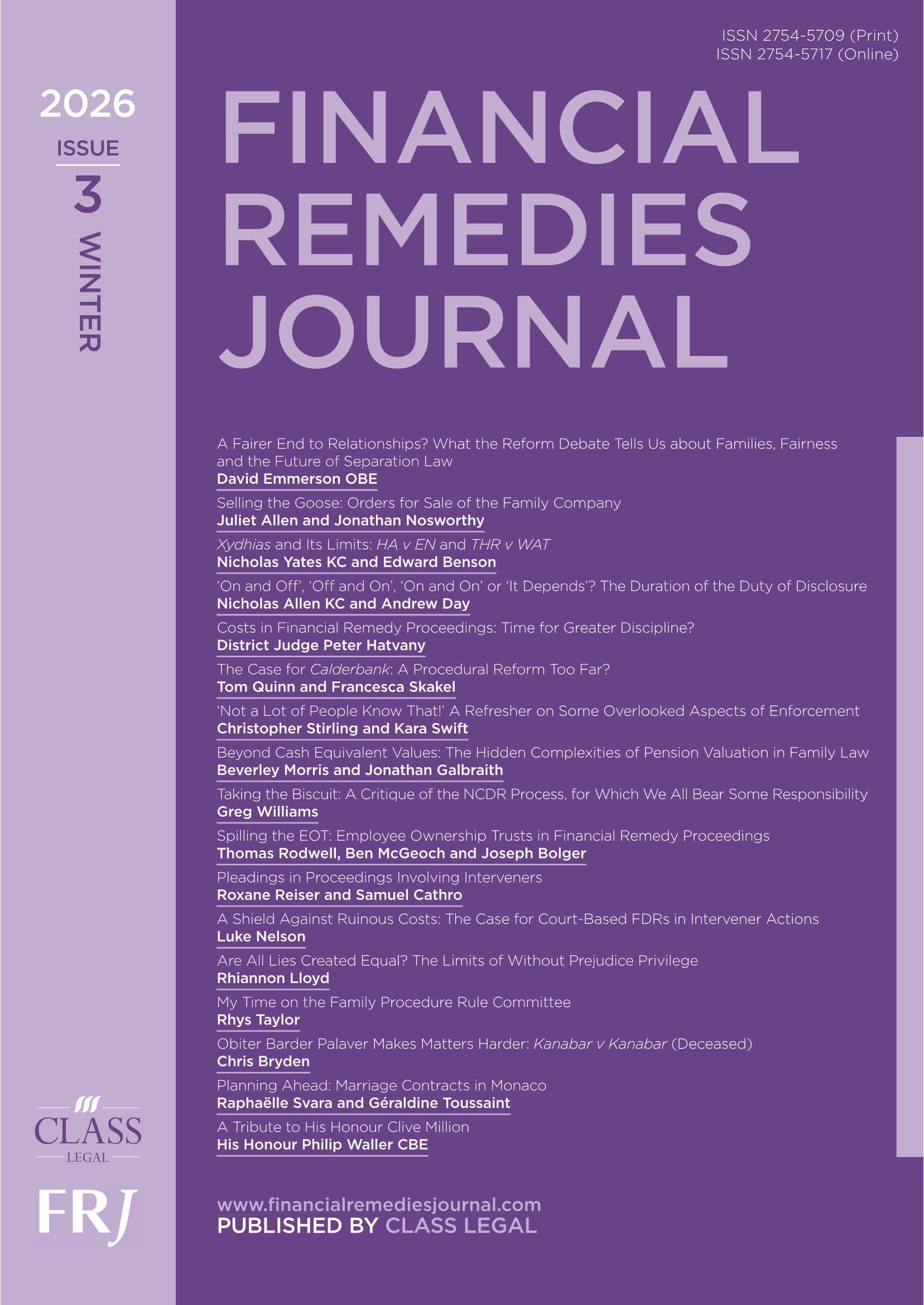
Now out: Financial Remedies Journal 2026 Issue 3 (Winter 2026)
The new issue of the Financial Remedies Journal is now available.
Links to individual articles in the issue are below.
Chair’s Column (Winter 2026) [2026] 3 FRJ 183 – HHJ Edward Hess. The Chair considers financial remedies reform, excessive costs and HHJ Stuart Farquahar’s retirement, remembers the late Sir James Munby and HHJ Clive Million, and announces the winners of the FRJ essay competition.
A Fairer End to Relationships? What the Reform Debate Tells Us about Families, Fairness and the Future of Separation Law – A Personal Review of the Responses from a Part-time Judge and Hybrid Mediator [2026] 3 FRJ 185 – David Emmerson OBE. This article focuses on the responses of four well-respected organisations to the government’s A Fairer End consultation: Rights of Women, the Family Solutions Group, Resolution and the Family Law Bar Association.
Selling the Goose: Orders for Sale of the Family Company [2026] 3 FRJ 194 – Juliet Allen and Jonathan Nosworthy. This article considers recent authorities which suggest that forcing a sale of the family company may increasingly be contemplated by the court. They include what is understood to be the first published case in which the court has ordered a sale over the business-owning party’s opposition, without giving that party the option of paying a lump sum to avoid it.
Xydhias and Its Limits: HA v EN and THR v WAT [2026] 3 FRJ 198 – Nicholas Yates KC and Edward Benson. This article aims to highlight some of the inherent issues presented by the concept of Xydhias agreements, namely the residual discretion that is left to the court to approve or alter those agreements, and the practical problems that result from this.
‘On and Off’, ‘Off and On’, ‘On and On’ or ‘It Depends’? The Duration of the Duty of Disclosure [2026] 3 FRJ 202 – Nicholas Allen KC and Andrew Day. When, precisely, does the duty of disclosure end, both in cases before the court and those proceeding via arbitration? The answer may be ‘it depends’.
Costs in Financial Remedy Proceedings: Time for Greater Discipline? [2026] 3 FRJ 206 – District Judge Peter Hatvany. If costs discipline is to be meaningful, parties must understand from the outset that disproportionate litigation expenditure will ultimately remain their own responsibility even in a needs case. The money spent on legal costs is money removed from the resources available to the family.
The Case for Calderbank: A Procedural Reform Too Far? [2026] 3 FRJ 208 – Tom Quinn and Francesca Skakel. There were legitimate objections to a costs system in which parties could face substantial consequences for failing to predict with sufficient accuracy the outcome of a highly discretionary financial remedy exercise. However, it does not follow that Calderbank itself was the problem.
‘Not a Lot of People Know That!’ A Refresher on Some of the Perhaps less Well-known or Sometimes Overlooked Aspects of Enforcement [2026] 3 FRJ 213 – Christopher Stirling and Kara Swift. Enforcement may be the ugly duckling of financial remedies work, but every financial remedy practitioner needs to be conscious of it, and not just after the event, but also at the time of drawing the final order itself.
Beyond Cash Equivalent Values: The Hidden Complexities of Pension Valuation in Family Law [2026] 3 FRJ 216 – Beverley Morris and Jonathan Galbraith. Valuing a private limited company can be fraught with difficulty. An expert report may produce such a wide range of figures that a court treats its conclusions as unreliable. Ultimately, it is for the court and not the expert to determine the value.
Taking the Biscuit: A Critique of the NCDR Process, for Which We All Bear Some Responsibility [2026] 3 FRJ 219 – Greg Williams. The purpose of this article is to examine whether our profession’s march towards NCDR has gone too far, too quickly. Litigants in person are now appearing every working day before real judges.
Spilling the EOT: Employee Ownership Trusts in Financial Remedy Proceedings [2026] 3 FRJ 222 – Thomas Rodwell, Ben McGeoch and Joseph Bolger. This article explores some of the valuation issues that can arise when dealing with EOTs within financial remedy cases and how family practitioners can approach these corporate structures.
Pleadings in Proceedings Involving Interveners [2026] 3 FRJ 226 – Roxane Reiser and Samuel Cathro. This article aims to assist financial remedy practitioners faced with directions for formal pleadings in proceedings involving interveners. It encourages the practice of disciplined pleading to ensure that the issues in dispute are properly delineated.
A Shield Against Ruinous Costs: The Case for Court-Based FDRs in Intervenor Actions [2026] 3 FRJ 230 – Luke Nelson. Warring parties, whose conflicts and costs are exacerbated by the introduction of other parties, are essentially being forced to litigate a dispute without any input from an unbiased judge. How did we get here?
Are All Lies Created Equal? The Limits of Without Prejudice Privilege [2026] 3 FRJ 235 – Rhiannon Lloyd. Where someone has admitted a relevant fact in a without prejudice letter and later denies the same fact in court, how can this be right? Fair? Most people assume this would not be protected by the without prejudice rule. This article examines whether that assumption is correct.
My Time on the Family Procedure Rule Committee [2026] 3 FRJ 240 – Rhys Taylor. The Vice Chair of the FRJ Editorial Board talks about his six years as a barrister member of the Family Procedure Rule Committee.
Obiter Barder Palaver Makes Matters Harder: Kanabar v Kanabar (Deceased) [2026] 3 FRJ 242 – Chris Bryden. The case of Kanabar v Kanabar (Deceased) & Anor [2026] EWCA Civ 582 involves, by its ratio, fascinating consideration of an important matter of law.
Planning Ahead: Marriage Contracts in Monaco [2026] 3 FRJ 246 – Raphaëlle Svara and Géraldine Toussaint. This article aims to provide English legal practitioners with a comprehensive overview of the Monegasque approach to marriage contracts and to draw clear distinctions between these instruments and the prenuptial agreements familiar to common law jurisdictions.
A Tribute to His Honour Clive Million [2026] 3 FRJ 250 – His Honour Philip Waller CBE. His Honour Philip Waller CBE remembers His Honour Clive Million, who died on 13 July 2026.
The Calculation Conundrum: Top-Up Maintenance After the Morgan Appeals [2026] 3 FRJ 252 – Christie O’Connell. A maximum CMS maintenance calculation is a condition precedent of a top-up order. But could a subsequent decision by the CMS bring the court’s order to an end?
Money Corner: Share Options – What Are They and How Do You Value Them? [2026] 3 FRJ 255 – James Hardy. Employee share options are increasingly encountered in financial remedy proceedings, particularly where a party works in a senior role. While they may receive less immediate attention than other assets, share options can represent a substantial component of an individual’s wealth.
DR Corner: Private FDRs – The Client’s Perspective [2026] 3 FRJ 262 – Hannah Budd. It is a truth universally acknowledged that Private FDRs (pFDRs) have been a force for enormous good. We all know and laud the benefits, but in reality how much have pFDRs really improved the experience for clients and, in fact, have they in some ways made things worse?
DR Corner: Why Private FDRs Work and How they Can Further Improve [2026] 3 FRJ 264 – Pauline Purcell. The Private FDR process may not be perfect, but it provides significant advantages for couples seeking to resolve a dispute regarding their financial settlement.
Tech Corner: Only 11%. What Technology Can Do About the Pensions Gap on Divorce [2026] 3 FRJ 266 – Josh Gordon. Only 11% of divorcees with a pension not yet in payment made any arrangement to share it, according to the Fair Shares study, which also found that over a third of divorcees did not know the value of their own pension. Ignoring the pensions is not an option.
Important Recent Case Developments (May 2026 to September 2026 inclusive) [2026] 3 FRJ 268 – Professor Polly Morgan. Noteworthy case law developments since the last issue went to press in the early autumn, including EC v EC [2026] EWFC 275 and Kanabar v Maganal Kanabar (Deceased) & Anor [2026] EWCA Civ 582.
The Summary of the Summaries (Winter 2026) [2026] 3 FRJ 270 – Liam Kelly. Recent cases from the FRJ website, including Ferrara v Ferrara [2026] EWCA Civ 512 and KMR v AER [2026] EWFC 10 (B).
Interview with His Honour Judge Stuart Farquhar [2026] 3 FRJ 273 – Anita Mehta and Charlotte John. What makes a persuasive advocate? What irritating things would judges like solicitors and barristers to stop doing? What causes most of the money appeals? HHJ Farquhar answers these questions and more.


Latest
Now out: Financial Remedies Journal 2026 Issue 3 (Winter 2026)
The Case for Calderbank: A Procedural Reform Too Far?