
TP v TF [2026] EWFC 210
29 July 2026. Garrido J. Final hearing addressing whether family trust assets should be considered matrimonial property and therefore subject to the equal sharing principle.
Judgment date: 29 July 2026
https://caselaw.nationalarchives.gov.uk/ewfc/2026/210
Garrido J. Final hearing addressing whether family trust assets should be considered matrimonial property and therefore subject to the equal sharing principle.
Background
This matter concerned the application for a financial order in a high-net-worth divorce between TP (W) and TF (H). W and H were married in 2001. They were both 63 at the time of judgment and had two adult children together.
A significant proportion of H’s wealth derived from a multi-generational family trust structure, which held shares (either directly or through underlying companies) worth several billion pounds. This included shares in a company, ABC.
In 1995, the trustees, acting in accordance with the wishes of H’s mother and uncle, notionally set aside 2.5% of the ABC equity to be allocated gradually to H over the course of an anticipated 30-year career in the company. This allocation was known as CAP. The CAP allocation was later reduced to 2.1% on account of H having left the business prior to the expiry of 30 years.
Two principal issues arose: whether the trust assets were a capital resource available to H; and, if so, whether it constituted a matrimonial asset to which the equal sharing principle would apply.
W’s position
W relied on the trustees’ Charman response of March 2026, which stated that the trustees ‘would be minded to make available to H, the vast majority, and potentially the entirety, of the value of CAP’, as evidence that the trust assets were capital resources available to H.
Furthermore, W argued that the entirety of CAP was matrimonial property. CAP had been established to reward H for his work at ABC, and therefore a resource generated during the marriage which was distinct from H’s general inheritance.
H’s position
H disputed the extent to which the trust assets were available to him, arguing that the trustees’ reference to the ‘vast majority’ ought to be interpreted conservatively. He relied, in particular, on the trustees’ continuing obligation to consider the interests of future generations.
H also submitted that CAP was, in substance, a form of ‘conditional inheritance’ and should therefore be treated as non-matrimonial property. H emphasised the ‘general culture’ of the trusts over time, which was to distribute income but preserve capital for future generations. H also relied on the fact that CAP originated from shares held within the family trust structure: a source external to the marriage.
In the alternative, H submitted that, even if CAP were found to be matrimonial property, equal sharing should be reduced to reflect the external source as well as H’s ‘special contribution’.
The availability of trust assets
The court adopted the legal principles outlined by Peel J in HO v TL [2024] 2 FLR 175 at [51] to determine the availability of trust assets. This included the well-established test in Charman, which is ‘whether the trustee would be likely to advance the capital immediately or in the foreseeable future’ (Charman v Charman [2025] EWCA Civ 1606, [13]).
Having considered the trustees’ Charman response, the court concluded that the trustees would be likely to make the entirety of CAP available to H if requested. The court found that the ‘vast majority’ in this case meant at least 95% and ‘potentially the entirety’ of the value of CAP. The court was therefore satisfied that CAP constituted a resource available for H for the purpose of financial remedy proceedings.
The matrimonialisation of family trust assets
The court concluded that CAP was an entirely matrimonial asset and therefore subject to the equal sharing principle. In reaching its decision, the court applied the principles established in Standish v Standish [2025] UKSC 26, particularly the Supreme Court’s clarification of the distinction between matrimonial and non-matrimonial property, and the circumstances in which the latter may become matrimonialised.
Firstly, though the notional allocation of shares to CAP originated from accumulated family wealth held within trusts, the purpose of CAP was to reward H for his endeavours on behalf of the family through his work at ABC. This distinguished CAP from H’s general inheritance. Those business endeavours had been supported and enabled by W throughout the marriage. The court emphasised that it is ‘by now uncontroversial that during the course of the marital partnership, there is no room for discrimination between husband and wife as to the different but complementary roles that each perform’; [60].
Secondly, the dramatic increase in ABC’s value during the marriage diminished the significance of H’s initial non-matrimonial contribution. Drawing on the pragmatic assessment endorsed in Standish, the court found that the proportion of CAP’s value attributable to H’s non-marital endeavours was ‘not sufficiently significant to justify an evidential investigation and/or an other than equal division of the wealth’ (Standish; [55]).
H’s alternative argument for a departure from equal sharing was also unsuccessful. The court emphasised that once property had been determined to be matrimonial, much of the justification for departing from equality falls away. Such departure should be supported by a principled basis, such as needs or compensation, which was not relevant here.
Conclusion
W was entitled to share equally in the entire net value of CAP. H was ordered to pay W approximately £120.4m, reflecting the equal division of CAP’s net value and other non-trust assets.
The court clarified that the entire net value of CAP did not need to be realised through the notional allocations made to CAP. Distributions could instead be made from a variety of trusts. The choice of distribution mechanism, including any considerations of tax efficiency, was therefore a matter for the trustees and H’s advisers.


Latest
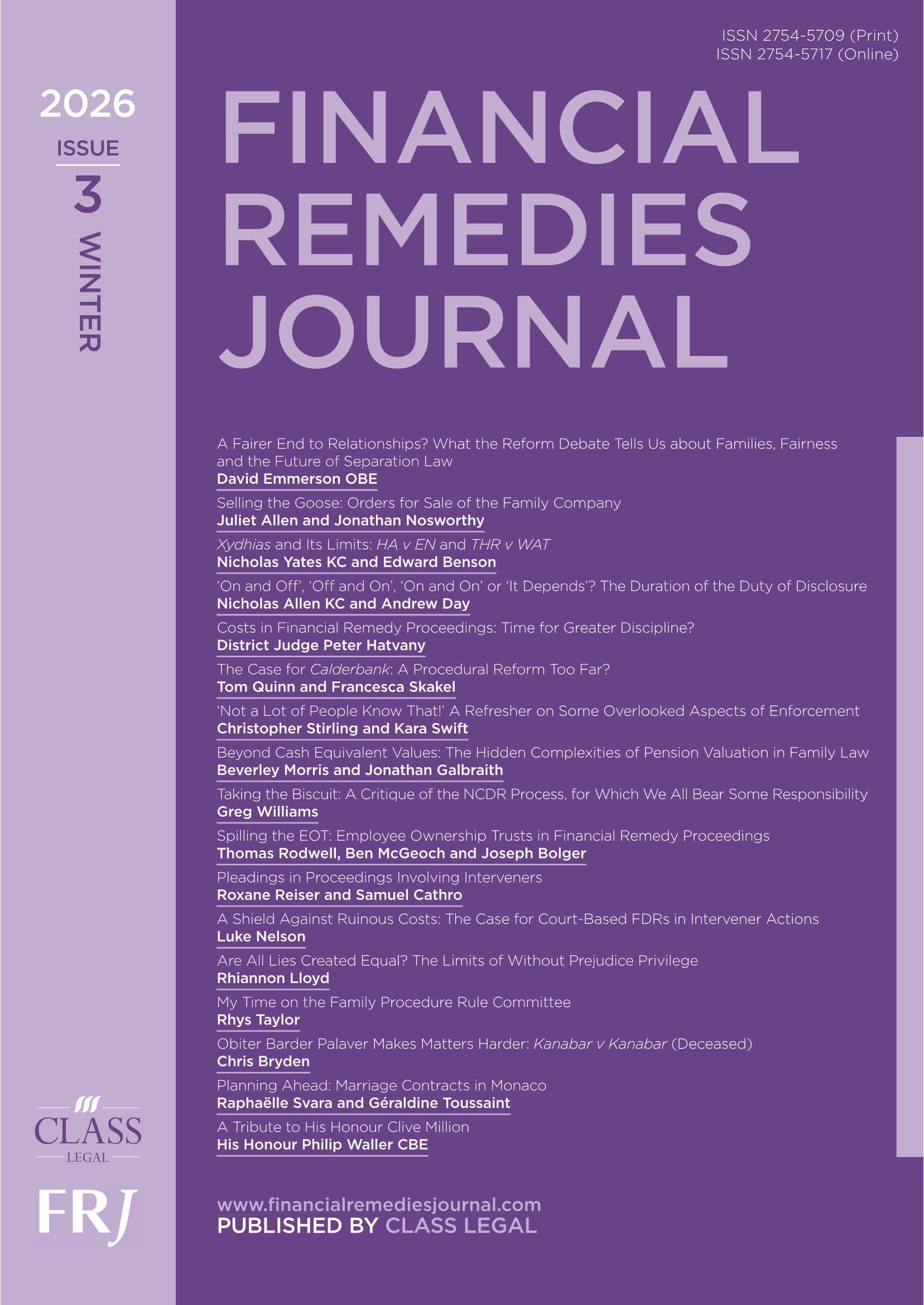
Now out: Financial Remedies Journal 2026 Issue 3 (Winter 2026)
The Case for Calderbank: A Procedural Reform Too Far?