
‘Not a Lot of People Know That!’ A Refresher on Some of the Perhaps less Well-known or Sometimes Overlooked Aspects of Enforcement
[2026] 3 FRJ 213. Enforcement may be the ugly duckling of financial remedies work, but every financial remedy practitioner needs to be conscious of it, and not just after the event, but also at the time of drawing the final order itself.
Introduction
Enforcement is something of the ugly duckling of financial remedies work. The glamour is in getting the great result for your client. However, that glamour can be rapidly tarnished if the other person fails to pay or transfer what is ordered. Every financial remedy practitioner needs to be conscious of enforcement and, as we impress in this article, not just after the event, but also at the time of drawing the final order itself.
This article is not intended to be a comprehensive review of all the various methods of enforcement and the procedural rules that apply. Such almost justifies a textbook. Rather, we seek to highlight some of the substantive and procedural aspects of enforcement that are perhaps not as well appreciated as they should be in a series of questions one might receive from a client.
Client query 1: When can I enforce my financial remedies order?
This may seem a silly a question. You have an order thus it can be enforced, right? However, a financial remedies order is not a standalone order. It is ancillary to the divorce, nullity or dissolution of civil partnership. After all, we used to call it ‘ancillary relief’. Thus, until you get the decree absolute/final divorce order you cannot enforce any lump sum, property adjustment or pension sharing order. Indeed, should death or bankruptcy intervene after the final financial order, but prior to the decree absolute/final divorce order, it may never take effect. So, the first tip is once you’ve got your final financial order make sure you get decree absolute/final divorce order as soon as possible (noting that this is, of course, going to be longer where there is a pension sharing order).
But what about the case of DH v RH (No 6) (Application to Set Aside) [2025] EWFC 175? Did MacDonald J not make an order under s 39 Senior Courts Act 1981 to sign transfer documents in aid of a property adjustment order where decree absolute was still outstanding? The answer is not entirely clear. The husband’s application for decree absolute was recorded as being before the court at the outset of the judgment dealing with enforcement. Thus, still outstanding. However, nothing further was said in the judgment about whether this was being granted or even considered. To be fair, there were a plethora of other issues in the case, the wife did not turn up and the husband represented himself. Moreover, there is no suggestion in the judgment that the point that the lack of decree absolute prevented enforcement was ever raised. It is thus more likely than not that the issue was simply overlooked. It is certainly not authority to suggest enforcement of a property adjustment order can proceed without decree absolute/final divorce order.
There are, however, some genuine exceptions to this general rule. The following orders can be enforced prior to decree absolute/final divorce order:
(1) periodical payments orders (whether as part of a separate MPS application or made at final hearing);
(2) LSPO orders;
(3) assessed or agreed costs orders.
In respect of costs orders, it is important to bear in mind they must be ‘liquidated’ to be enforced. An order that a party pays costs to be agreed or the subject of detailed assessment is not liquidated and thus not enforceable until the amount is fixed either by agreement or assessment. Detailed assessment can be both expensive and time consuming. It is for that reason generally more beneficial to seek summary assessment of costs, even after a trial, in order to have a liquidated order.
It is worth remembering that there is no rule that there cannot be summary assessment after a hearing lasting more than a day, it merely ceases to be the default in that situation. Indeed, the costs rules state summary assessment should always be at least considered – CPR PD 44, para 9.1 (imported into the FPR by FPR 28.2). The experience of the authors is that Family Court judges will consider summary assessment perhaps more readily than civil judges even in longer cases. Even where a judge declines summary assessment it is still worth asking for a payment on account of such costs and any sum so allowed is itself enforceable as a liquidated sum. This is extremely common in civil proceedings but perhaps less used in family cases, though there is no reason in principle why that should be so.
In any case, where costs are likely to be sought summarily, a Form N260 setting out the detail of the costs claimed should be served 24 hours before the relevant hearing – it is not sufficient to rely on Form H or even Form H1 – FPR PD 28A, para 4.5.
Lastly, it should be noted that although standalone enforcement needs to await decree absolute/final divorce order, that does not mean that enforcement cannot be baked into a final financial order. If the facts of the case justify it, for example, a charging order, third party debt order or attachment of earnings order may actually be made with and at the same time as the final financial order.
Client query 2: How do I enforce in the Family Court?
FPR 33.3(2)(b) allows the unique opportunity to make a general application for such method of enforcement the court may consider appropriate. That allows you to keep all of the enforcement options open and pursue potentially numerous methods of applicable enforcement at the same time. The court may make any of the following orders at the same time or subsequently, following examination of the debtor’s means:
(1) Attachment of earnings.
(2) Third-party debt order.
(3) Charging order, stop order or stop notice.
(4) Writ or warrant of execution (seizure and sale of personal property).
(5) Appointment of a receiver.
It is not an either/or approach. The general application made in Form D50K can be filed alongside standalone applications for specific methods of enforcement. Notably, the general application cannot be used to pursue committal because of the hybrid process of oral examination that follows the filing of the Form D50K application. Per Mubarak v Mubarak (No 1) [2001] 1 FLR 698 there can be no such compulsion of evidence in committal proceedings which must be pursued separately and specifically.
Orders for sale do not cease upon the making of the final financial order. The court has the power to make a standalone order for sale as a method of enforcing lump sums and property adjustment orders. That allows for a quicker process compared to obtaining a charging order and thereafter an order for sale but their use is limited. An order for sale cannot be made to recover costs orders or arrears of periodical payments. There is also nothing to stop the debtor dealing with the property pending the order being made. Therefore, caution should be exercised if there are other potential creditors.
Client query 3: I’ve got a lump sum order with an order for sale in default. The lump sum has not been paid and I’ve heard my ex has recently been made bankrupt. What can I do?
The desirability of including an order for sale in default of payment of a lump sum is generally well known and indeed self-evident. It provides an automatic enforcement mechanism. However, what is generally less well known is that it also provides, once there is decree absolute/final financial order, a form of automatic security in respect of the lump sum amount by way of an equitable charge on the property identified for sale. This provides much wider protection against third party claims, including bankruptcy or charging orders, than a standalone lump sum order.
Authority for this proposition can be found in DW & CW v GC [2016] EWHC 2965 (Fam), [2017] 4 WLR 80. There, a lump sum order by instalments had been made in favour of the wife. The order stated that in default of payment of any of the instalments, a property owned by the husband would be sold to meet the balance outstanding. The husband had, subsequent to the order, purported to declare a trust in favour of his new partner in respect of the relevant property and thereafter had been declared bankrupt. The husband had defaulted on the instalments. The question arose as to whether the wife could still enforce by her order for sale despite the bankruptcy.
Moylan J was surprised that there was no authority he could find directly on point. However, he had regard to the civil Court of Appeal decision in Hughmans Solicitors v Central Stream Services (In Liquidation) [2013] 1 EGLR 27. There, it had been held that an agreement within a Tomlin order to sell a property belonging to one party out of which proceeds of sale a sum was to be paid to another party, created an immediate equitable interest in the property in favour of the other party. This equity was up to the amount of the outstanding debt. Furthermore, this equity would take priority to any subsequent charging order. Moylan J thought the position was, if anything, stronger where the obligation arose in the body of a court order.
He also had regard to the financial remedy case of Mountnay v Treharne [2002] EWCA Civ 1174, [2003] Ch 135. There the Court of Appeal held that a property adjustment order took effect in equity on the making of the order combined with decree absolute, prior to its implementation by legal conveyance. This in turn had been partly based on the 19th-century Maclurcan line of authority that established that a provision for maintenance to be secured on a property created an immediate equitable charge over the property, prior to the implementation of any legal charge, provided such property was sufficiently identified.
Drawing those threads together Moylan J concluded that the wife had an equitable charge in the property that took priority to any subsequent charges or dealings by the husband. Further, the husband’s trustee in bankruptcy took his interest in the property subject to this equitable charge.
Thus, if there is any concern that the payor of a lump sum may be susceptible to bankruptcy or have other creditors sniffing around it is highly advisable to have any lump sum order backed up, if at all possible, by an order for sale in respect of identified property.
An equitable charge is, of course, not entirely secure in that it only takes priority to charges created after it. Moreover, it does not of itself protect against an early sale to a purchaser for value without notice and the judgment debtor then scuttling off with the proceeds of such sale. However, this latter risk can be mitigated by placing restrictions on the title at the Land Registry. These can either be by way of an agreed restriction or, if necessary, protected by a unilateral notice. Any subsequent purchaser would thereafter be in real difficulty in showing a lack of notice.
Client query 4: I’ve got an unpaid costs order which is now more than 6 years old. My ex owns a property. Can I still enforce the costs order after this amount of time?
The short answer is ‘yes’ and the most obvious and easiest way to do so on these facts is by a charging order. There is no formal time limit for charging order applications. Charging orders are a form of execution and not a fresh action. Thus, the limitation period for an action as contained in s 24(1) Limitation Act 1980 does not apply: Lowsley v Forbes [1999] 1 AC 329. This means charging orders may be used to enforce orders made long ago and, in particular, judgment debts and costs orders made over 6 years prior to the application. The only limit that applies is that conferred by s 24(2) Limitation Act 1980. This limits any interest claimed on the judgment debt or costs order to 6 years from the date of judgment. There is, however, no limitation bar to making the charging orders themselves.
Nor is there any procedural requirement to seek permission of the court to enforce a charging order after 6 years. Nowhere in FPR Part 40 nor the Charging Orders Act 1979 (nor indeed CPR Part 73) is there any mention of an express or implied requirement for permission to bring charging order proceedings to enforce a judgement more than 6 years after it was made (this is in obvious contra-distinction to other forms of execution). Given the absence of such requirement in the rules or statute there is no basis for implying such a rule: a point confirmed by the Court of Appeal in Fraenkl-Rietti v Cheltenham & Gloucester Plc [2011] EWCA Civ 524.
Further, once obtained, charging orders have an almost indefinite shelf life. In Yorkshire Bank Finance Ltd v Mulhall [2008] EWCA Civ 1156, the Court of Appeal refused to set aside a charging order made more than 16 years previously. Moreover, there is no limitation on interest accruing on the sum secured by the charging order. Once the charging order is made, interest is arising on the secured debt and not the underlying judgment and thus the 6-year interest limit under s 24(1) Limitation Act 1980 is of no application.
One of the implications of this is that it may well be worthwhile obtaining a charging order even when there are concerns regarding the extent of any equity in the property it is proposed to charge. This is because such equity may increase over time during which time the debt is accruing interest.
A word of caution, however. It is not necessarily a good idea to leave a charging order in place for a long time, at least without good reason. The vintage of a charging order may affect the likelihood of a court ultimately exercising its discretion to order an immediate sale of the property to enforce the charge. This is a separate and subsequent process to obtaining the charging order – though as VS v RE [2018] EWFC 30, [2018] 2 FLR 1213 made clear, such application can still be made in the Family Court. This does not mean the charge is of no value but if the court will not order an immediate sale, it defers the realisation to the time the judgment debtor chooses to sell or otherwise has a sale forced upon them.
Client query 5: I can already see the writing on the wall. They have already tried to plead that they do not have sufficient means to pay the maintenance, and I know they won’t comply with the order. Am I staring down the barrel of the gun of inevitable enforcement?
It will take a very specific set of circumstances to be able to convince a judge that the other person is going to refuse to comply with an order that has not yet been made, but we have all seen those cases. Parties who have failed to comply throughout the proceedings; the cases that ran on inferences; those litigants in person who have been brazen enough to say that they cannot and won’t afford the maintenance. Convincing the judge to make the maintenance order is only half of the battle. Rarely is security sought at that stage. Cue, an attachment of earnings order being made at the time of the periodical payments order in the final financial order.
Client query 6: There are no identifiable assets against which I can seek a third-party debt order but I know they have been paying their solicitor, what if there are still funds sitting there?
There is an ongoing debate that funds held in a solicitor’s client account can be the subject of a third party debt order. Historically, third party debt order applications were refused on the basis that it could not be proven that the funds were owed by the solicitors to the judgment debtor. However, in BCS Corporate Acceptances Ltd & Ors v Terry [2018] EWHC 2349 (QB), Morris J accepted that funds held on account of future fees remained a debt due to their client and were accordingly capable of being the subject of a third party debt order. This can only be argued once the application is no longer ex parte, but McKendrick J recently confirmed in A v Z (No 2) (Interim Third Party Debt Order) [2026] EWFC 90 that an interim third party debt order could be made. There remains a clear warning that a judge will be cautious to tread the line between depriving a judgment debtor of litigation funding and the negative effects caused by their non-compliance, but there is authority that can get your foot in the door.
Note: this article is based on content from the Resolution Podcast – Talking Family Law, S5 Episode 10: ‘Enforcement of financial remedy orders’ where Christopher and Kara joined hosts Anita Mehta and Simon Blain.


Latest
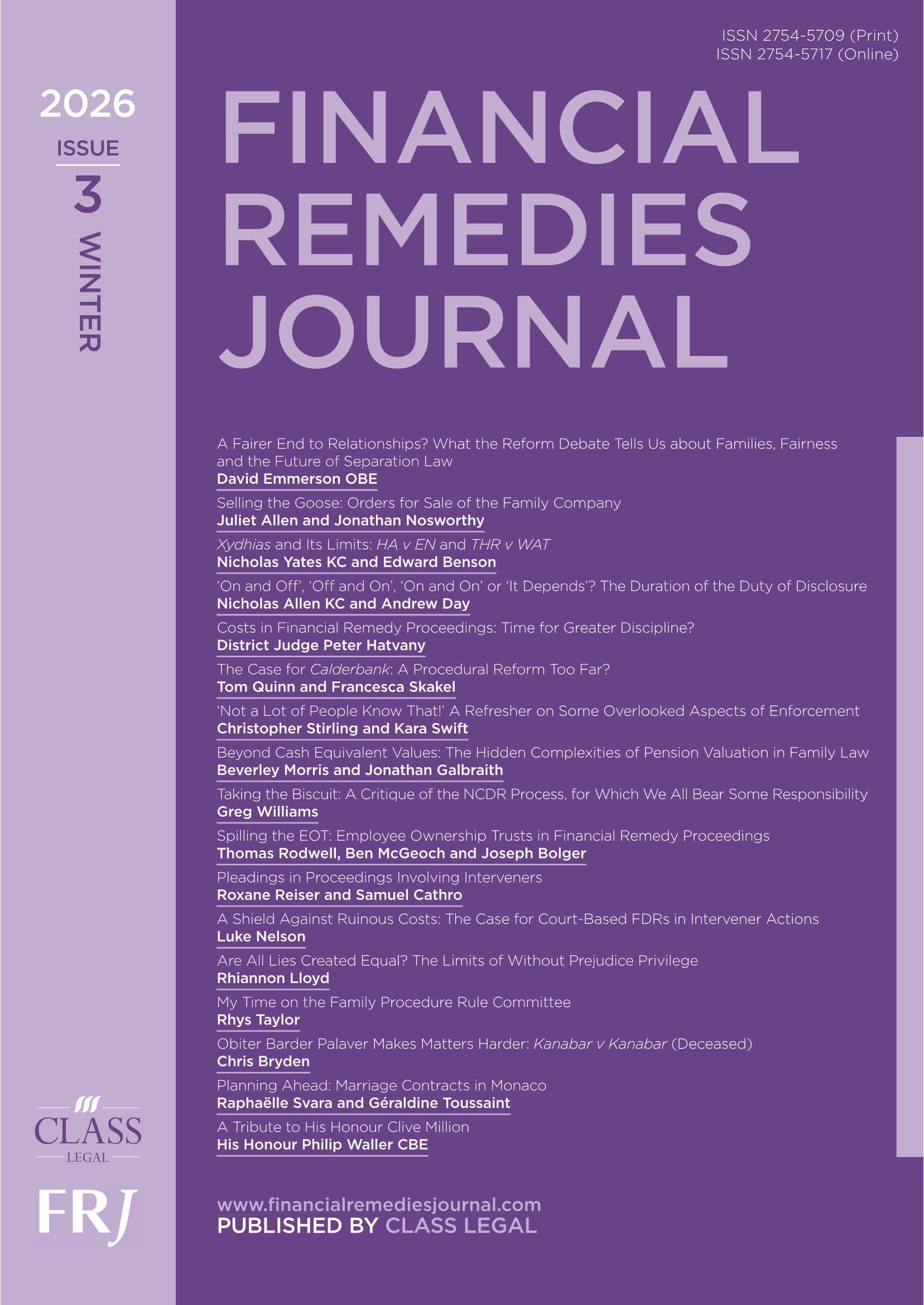
Now out: Financial Remedies Journal 2026 Issue 3 (Winter 2026)
The Case for Calderbank: A Procedural Reform Too Far?