
Spilling the EOT: Employee Ownership Trusts in Financial Remedy Proceedings
[2026] 3 FRJ 222. This article explores some of the valuation issues that can arise when dealing with EOTs within financial remedy cases and how family practitioners can approach these corporate structures.
Introduction
The sale of a private company to an employee ownership trust (EOT) has, to date, received generous tax treatment. In this article, we explore some of the valuation issues that can arise when dealing with EOTs within financial remedy cases and how family practitioners can approach these corporate structures.
What is an EOT?
An EOT is exactly what it says on the tin. It is a trust that exists to hold shares in a company for the benefit of the company’s workforce. Introduced in the Finance Act 2014 by Chancellor George Osborne, the aim of EOTs was to encourage more companies to move to an employee ownership model. The incentive to do so was achieved by the business owner selling their shares to the EOT receiving 100% relief from capital gains tax (CGT) on the transaction (providing that certain qualifying conditions were met).[[1]]
Since their introduction, there have been several amendments to EOT legislation, including the Finance Act 2026, in which Chancellor Rachel Reeves halved the CGT relief for sales to EOTs, resulting in only 50% of the seller’s gain being exempt from CGT from 26 November 2025.[[2]] Nevertheless, and as a result of the generous tax benefits on offer, sales to EOTs are a popular way in which business owners can dispose of their shares in their companies.
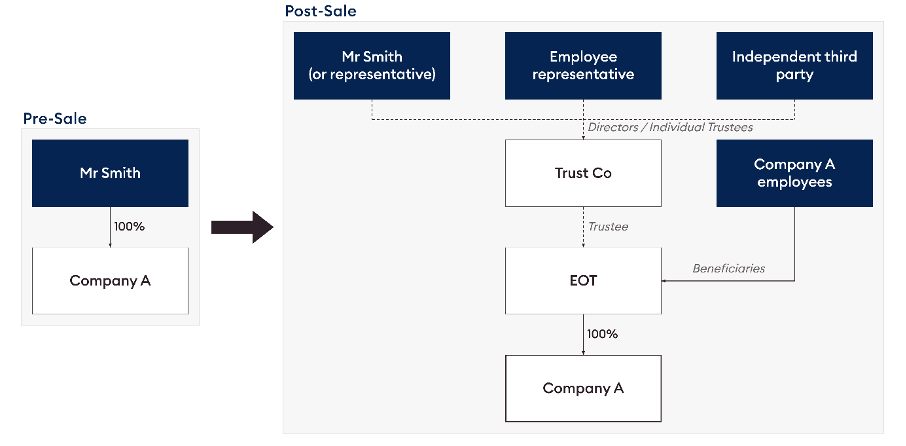
By way of high level example, in Figure 1 we show an example schematic depicting the sale of a company to an EOT.
[[1]]: Finance Act 2014, s 290/Sch 37.
[[2]]: Strictly speaking, the gain is not fully extinguished but is instead reflected in the base cost for the trustees. Specifically, the base cost of the shares acquired by the trustees is deemed to be the consideration paid less the portion of the gain that was exempt for the seller. That said, from the seller’s perspective, the relief functions as an exemption. Finance Act 2026, s 35.
As business valuers, we see a large number of financial remedy proceedings in which one of the parties has sold a company to an EOT. It raises a number of interesting valuation questions which we discuss in this article.
The high level structure of an EOT
In most cases, EOTs are newly established as part of a pre-arranged sale process. As a result, the EOT which is to acquire the underlying company often has limited cash or assets with which to purchase the shares from the seller. Instead, the seller is usually paid by a combination of: (1) an upfront payment, often using existing cash reserves held within the company; and (2) deferred consideration, funded from the company’s future profits.[[3]]
The EOT itself exists to hold the shares in the underlying company for the benefit of the employees. It follows, therefore, that the beneficiaries of the EOT are typically the employees, as a whole, with the trustees often, in our experience, taking the form of a single corporate trustee or ‘Trust Co’. This Trust Co is often a newly incorporated company whose directors (sometimes referred to as the ‘individual trustees’) can include the seller themselves or a representative appointed on their behalf, a representative or representatives of the employees, and independent third parties.[[4]]
In our experience, the sellers (or their representatives) often cease to act as an individual trustee following the full repayment of all deferred consideration, or following the end of some other trigger event, such as the passing of an agreed amount of time.
Valuations where an EOT sale has occurred
How to approach it then, when an EOT appears in a Form E? How do you assess the relevant value where a party to proceedings has sold their shares in a company to an EOT?
First, it is important to define what interest or asset actually requires valuation. This in turn depends on the valuation date. For example, if the valuation date is the date of the sale (or prior), the relevant asset may be the shares in the company itself. Alternatively, if the valuation date is after the sale, then the relevant interest to be assessed may no longer be the shares in a company, but rather the debt that is owed to the seller in the form of deferred consideration, which may be paid out over a number of years by the EOT, from profits generated by the underlying company.
Valuing the company at the time of the sale
Since 30 October 2024, trustees to EOTs have been required to ‘take all reasonable steps to secure that the consideration for the disposal does not exceed the market value of the ordinary share capital at the time of the disposal’.[[5]] Does this mean that the sale price provides a reliable indication of market value for the purposes of financial remedy proceedings, as at the date of the sale?[[6]]
Unfortunately, the reality is often not that simple. There are a number of potential issues with simply adopting the headline sale price as the value of the business. These can include:
(1) a lack of consistency with market value, namely whether the sale of a company to an EOT can be said to be at market value will be fact-specific and depend on the process adopted by the seller and the EOT in reaching the agreed sale price;
(2) risk and timing and the potential failure to account for risk and time of receipt when setting the level and rate of payment of any deferred consideration; and
(3) tax benefits and the role that such benefits can play in determining the sale price.
We discuss each of these issues, in turn, below.
Is a sale to an EOT consistent with the IVS definition of market value?
Market value is defined by the International Valuation Standards (IVS), as:
‘the estimated amount for which an asset and/or liability should exchange on the valuation date between a willing buyer and a willing seller in an arm’s-length transaction, after proper marketing and where the parties had each acted knowledgeably, prudently and without compulsion.’[[7]]
There are a number of aspects of this definition which may not align with the realities of an EOT sale:
(1) negotiation between buyer and seller – the IVS definition of market value assumes a well informed and willing buyer negotiating the price downwards and a well informed and willing seller negotiating the price upwards. It is that inherent tension that, ultimately, results in the price being market value. However, this is not necessarily the case with a sale to an EOT, where there may be limited ability for the buyer (e.g. the Trust Co which acquires the company on behalf of the EOT) to negotiate or decide to walk away from the deal. The extent to which external third party opinions or analysis are relied upon by either the seller or the EOT when contemplating the sale is likely to be relevant information when considering this aspect;
(2) ‘arm’s-length transaction’ – the IVS definition of market value requires that the buyer and seller do not have a relationship that may cause a departure from the market price. However, in an EOT sale, the Trust Co, acting as the buyer: (1) has typically been established at the seller’s direction; (2) usually includes a representative of the seller on its board of directors (until the full proceeds have been paid); and (3) is often advised by professionals introduced by the seller. These factors cast doubt over whether the transaction can truly be considered to be arm’s length; and
(3) lack of market exposure – the IVS definition of market value requires adequate exposure of the asset to the market, with competing bidders driving the price towards an appropriate market value. In an EOT sale, there may be no exposure of the business to the open market, with no competing bidders. Again, this factor can have a bearing on whether the sale of an EOT can be said to meet the definition of market value.
Failure to account for risk and time of receipt
According to finance theory, cash received in the future is less valuable than the same sum of cash received today. Therefore, when considering the value of deferred consideration (i.e. consideration to be received following the sale of an EOT) it can be appropriate to apply a discount to those future cash receipts. This discounting is typically achieved by the application of a discount rate that reflects two distinct factors, namely:
(1) the ‘time value of money’, which in simple terms, states that £100 received today is more valuable than £100 received at some point in the future, say, in one year’s time. This is because £100 received today could be invested to earn a return in the intervening period; and
(2) the risks associated with the cash flows. The term ‘risk’ can have different meanings in different contexts. In the case of EOT sales, these risks relate to both the company’s ability to generate cash flows that are used to pay the deferred consideration to the seller, as well as the risks associated with the Trust not paying the deferred consideration to the seller (although in circumstances where the seller, or their representative, remains as a trustee of the EOT, this risk can be somewhat mitigated).
As we note above, given that EOT sales can often involve significant elements of deferred consideration to be paid out of the company’s profits in future years, it may be necessary to apply a discount to the sale price to arrive at the market value of the company equal to the present value of those future receipts.
The appropriate discount to apply will depend on a number of factors such as the timing of the receipts, the contractual terms of the EOT sale, and the risk profile of the business. However, and importantly, if a discount is deemed to be necessary, this would imply that the stated sale price may be in excess of market value.
Requirement to consider tax benefits
Another factor that a valuer may also need to consider is the tax benefit of an EOT sale. This is because typical trade or private equity sales of companies may incur significant CGT liabilities for the seller, whereas an EOT sale grants full (before 26 November 2025) or partial (from 26 November 2025) relief from this tax.[[8]]
As a result, a seller may be willing to accept a lower sale price in an EOT sale, as compared with a typical trade or private equity sale, given that an EOT sale would result in the same or greater proceeds, net of tax.
Such considerations will always be fact-specific. Nevertheless, if this is the case, it may be that the sale price of an EOT sale is below the market value that a purchaser would have paid in an open market sale. As such, and in order to compare ‘apples with apples’, it may make sense to compare net of tax proceeds, rather than the gross sale price if seeking to compare an EOT sale to an open market sale to a trade or private equity buyer.
Can an EOT sale price be relied upon at all?
That all being said, the agreed price of an EOT transaction is often based on a contemporaneous valuation analysis which, if well performed, may be a reasonable estimate of the market value as at the time of the sale. Further, it can also be argued that an independent, contemporaneous valuation report, if performed, in combination with the seller and the Trust Co both accepting the valuation conclusions therein, will provide a reasonable indication of value, as at the time of the transaction.[[9]]
Valuing the debt after the sale
As we explain above, if the relevant valuation date is after the sale, i.e. if what appears in the Form E is the future cash proceeds to be received by the relevant party following an EOT sale, then the relevant asset may no longer be shares in the company itself, but rather the debt that is owed to the seller (in the form of deferred consideration), which is often paid out over many years.
In order to reliably assess the value of this debt, i.e. the deferred consideration, a number of factors will need to be considered, including:
(1) the contractual terms of the EOT sale;
(2) payments already made, which have the effect of reducing the balance owed;
(3) the anticipated timing of future payments, and the time value of money;
(4) the risk attached to the company’s cash flows, and its ability to generate sufficient profits to pay future deferred consideration;
(5) any outstanding CGT relating to the disposal; and
(6) any further information arising after the sale, but before the valuation date, which may impact the value of the debt to the seller.
In practice, a valuer may value the debt using the discounted cash flow (DCF) method, in which the above factors will be reflected in the assumed future cash flows and the application of an appropriate discount rate to reflect and quantify the relevant risks. However, DCF valuations can be highly sensitive to their inputs and so it is important to ensure that the assumed cash flows and discount rates are appropriate and reasonably assessed.
Conclusion
Sales to EOTs have become an increasingly common method by which business owners exit their companies in a tax-efficient way. This means that, as financial remedies practitioners, we need to be aware of the issues that can arise with EOTs, as and when they appear in Forms E and asset schedules. As we note above, EOTs can also bring with them a host of interesting valuation questions.
Where a valuation is required, it is first important to establish the valuation date, which will inform whether it is the shares in the company, or the seller’s right to collect deferred consideration, that need to be valued.
If the shares in the company are to be valued, the sale price is a natural point of reference, though the discussion above shows why it may not be as simple as adopting the sale price without further scrutiny. If the seller’s right to collect deferred consideration is to be valued, then an appropriate valuation will need to take into account several factors, such as the contractual terms, the expected timing of the remaining payments and the company’s ability to make them.
[[3]]: See, e.g. ICAEW, ‘Need to know: employee ownership trusts’, 18 February 2025.
[[4]]: A comprehensive guide to the legal requirements around the formation and running of EOTs is beyond the scope of this article (and the author’s expertise!) but the following are helpful guides: ‘Trusts and taxes’, www.gov.uk/trusts-taxes; and ICAEW, ‘Need to know: employee ownership trusts’, 18 February 2025.
[[5]]: Finance Act 2025, Sch 6.
[[6]]: Market value is adopted by Mostyn J in FZ v SZ [2010] EWHC 1630 (Fam) as the ‘usual measurement of value’ ([118]).
[[7]]: IVS 102 Bases of Value: A10. Market Value.
[[8]]: Finance Act 2014, s 290/Sch 37 and Finance Act 2026, s 35.
[[9]]: Ultimately, however, the reliance that can be placed on such evidence will always be fact-specific and depend upon the circumstances of the transaction, including the ability of the Trust Co to act independently from the seller, and whether each party to the transaction was sufficiently well informed.


Latest
Now out: Financial Remedies Journal 2026 Issue 3 (Winter 2026)
The Case for Calderbank: A Procedural Reform Too Far?